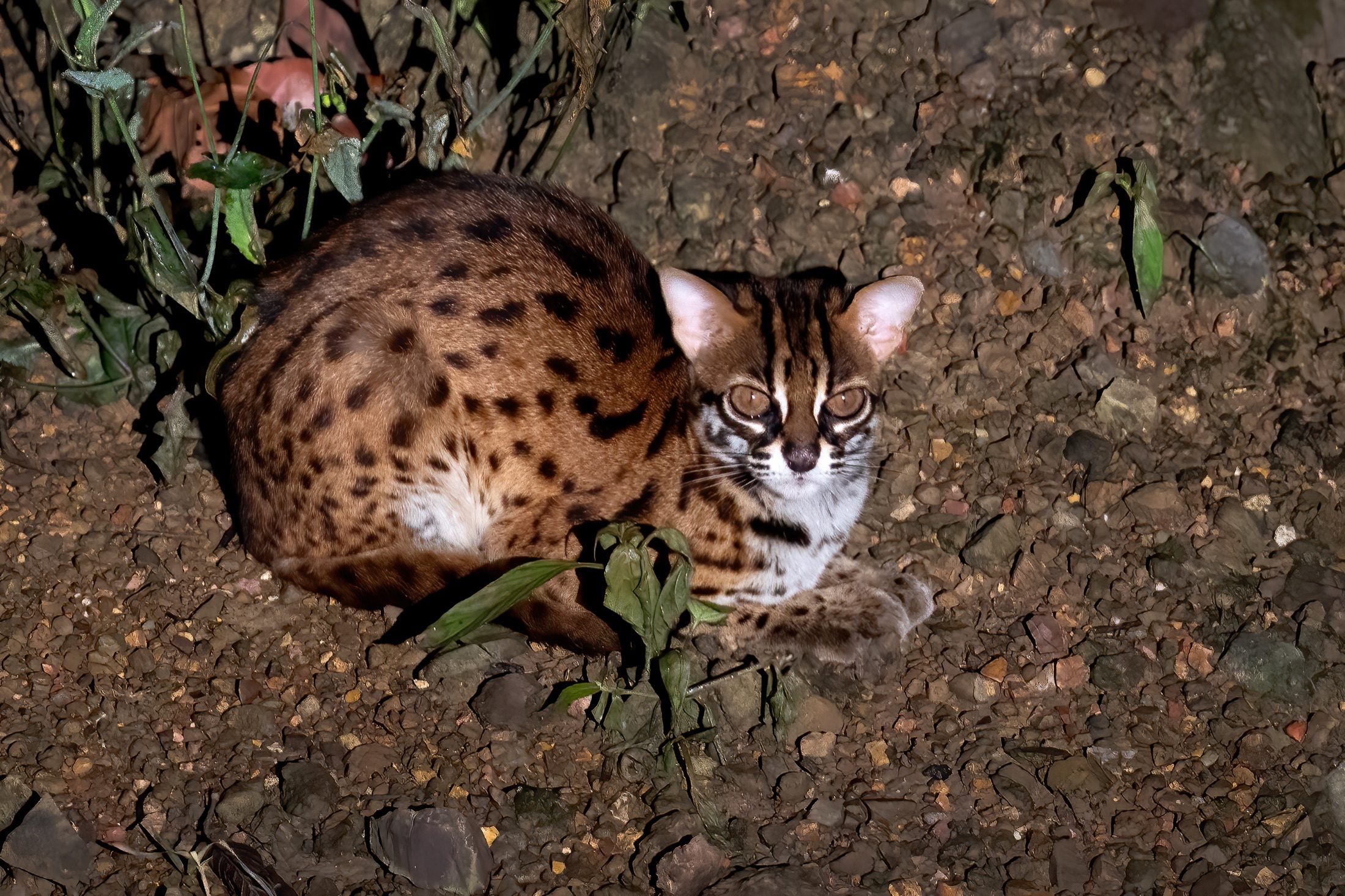
Wild image · Tabin Wildlife Reserve · Sabah, Malaysia
Meet the cat
Sunda leopard cat
Prionailurus javanensis
The island counterpart of the mainland leopard cat, now recognized as a distinct species.
ConservationNot EvaluatedNE
Relative sizeSmall
ActivityNocturnal
LineageLeopard cat
Weight1.6–8 kg
Body length45–65 cm
Tail length20–30 cm
One familiar-looking cat. A different island story.
The split that reveals how much geography matters.
At first glance, the Sunda leopard cat can look like a miniature leopard—or like its mainland relative. The distinction becomes clearer when genetics, morphology, geography, and long isolation are considered together.
This cat belongs to islands and island systems: Borneo, Sumatra, Java, Bali, and parts of the Philippines. Its story is not simply that a name changed. It is that populations separated by water can carry different evolutionary histories, different pressures, and different conservation needs.
Habitat and range
A forest cat that sometimes lives beyond the forest.
Sunda leopard cats use tropical forest, forest mosaics, swamp forest, scrub, and selectively logged landscapes. They have also been recorded in oil-palm and sugarcane country, although the ability to enter altered habitat should not be confused with freedom from risk.
They are mainly nocturnal and crepuscular, but activity can extend into daylight. They hunt on the ground and in trees, climb well, and swim—abilities that help explain their presence across an island-rich range.
How it belongs
Built for this particular world.
A small, versatile hunter
At home above and below
Island variation matters
The conservation reality
Adaptable does not mean secure.
The Sunda leopard cat has not yet received a separate global IUCN Red List assessment following its recognition as a species. Available evidence suggests it can be locally common, while some island populations face severe pressure.
- Forest loss and fragmentation
- Hunting and direct killing
- Higher mortality in heavily disturbed landscapes
- Isolation and habitat scarcity on small islands
- Large information gaps after the taxonomic split
What effective work looks like
Treat the islands as distinct conservation realities.
A single broad label can hide very different local circumstances. Conservation needs range-specific evidence and attention to populations that may otherwise disappear inside a reassuring global average.
Reassess after the split
Population, distribution, and threat data need to be evaluated for the Sunda species rather than inherited from the former combined leopard-cat assessment.
Protect remaining connections
Forest cover and movement routes matter even where cats also use plantations or agricultural mosaics.
See the island populations
Survey and protection priorities should reflect the acute vulnerability of restricted Philippine and other island populations.
From hope to participation
Following the science is part of protecting the animal.
Zoo-EV will keep this account visibly dated and revise it as the specialist assessment changes. Participation begins by sharing the distinction accurately: the Sunda leopard cat is not merely a mainland leopard cat living on an island.
Participate in the missionScientific sources, review, and image provenance
Scientific review: August 22, 2026. This account will continue to change when stronger evidence or updated specialist assessments become available.
- IUCN SSC Cat Specialist Group · Sunda leopard cat
- Mammal Diversity Database · Prionailurus javanensis
- 2017 revised taxonomy of Felidae
- Image: JJ Harrison · wild · Tabin Wildlife Reserve · Sabah, Malaysia · CC BY-SA 3.0