
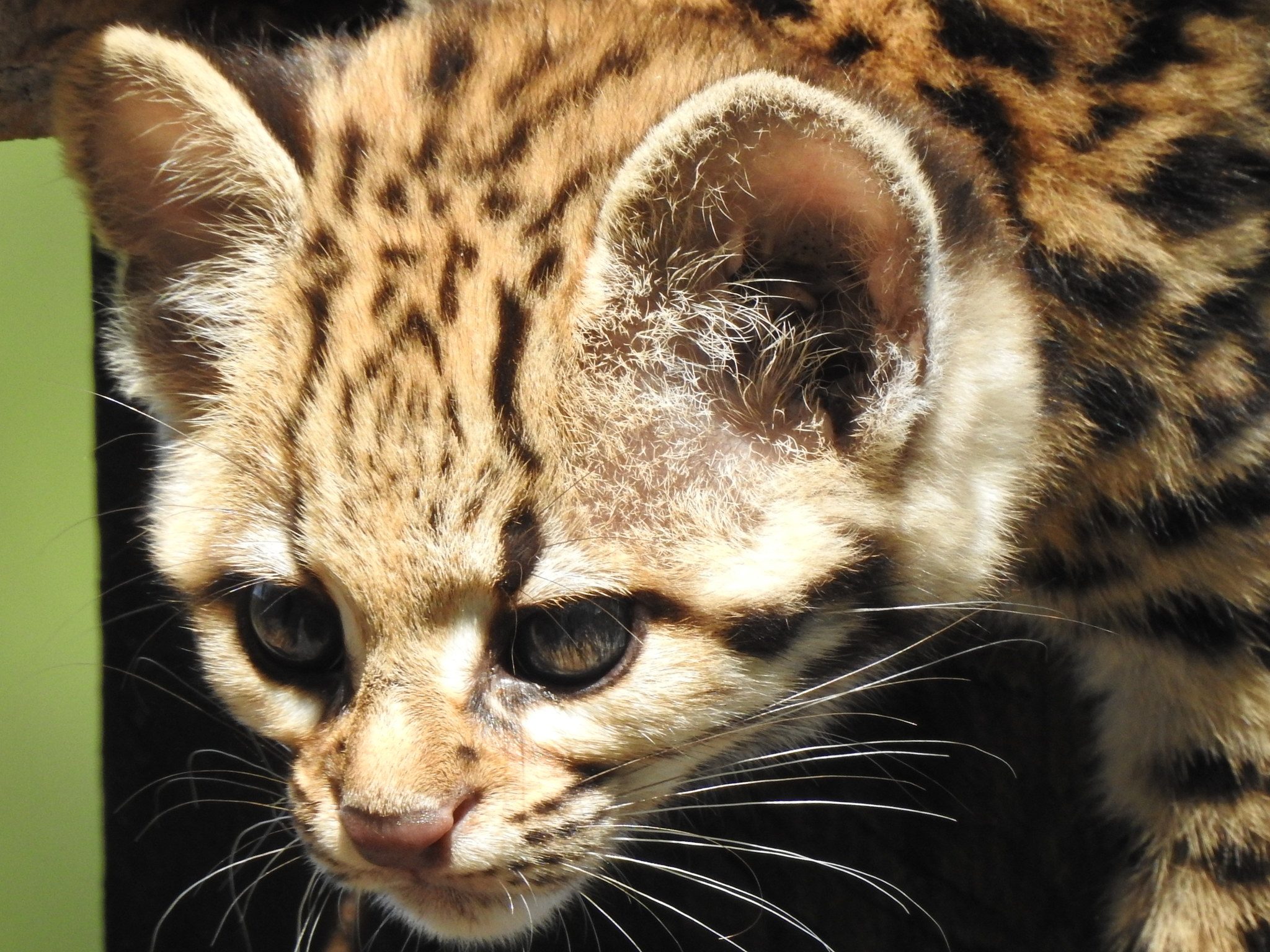
Wild image · Canindeyú · Paraguay
Meet the cat
Southern tiger cat
Leopardus guttulus
A small spotted cat tied closely to the Atlantic Forest and neighboring landscapes.
ConservationVulnerableVU
Relative sizeSmall
ActivityNocturnal
LineageOcelot
Weight1.8–3.5 kg
Body length38–59 cm
Tail length20–42 cm
A tiny cat negotiating a crowded forest
Sometimes the safest time to be a night cat is daylight.
Southern tiger cats are mainly nocturnal, but some become active by day where ocelots are common. Researchers call the larger cat’s suppressing effect on smaller felids the “ocelot effect.” Changing shifts may help this house-cat-sized hunter avoid a dangerous neighbor.
The southern species tends to be slightly sturdier than the northern tiger cat, with smaller rounded ears, a thicker tail, and dark-edged rosettes. Those clues are tendencies, not a field-test answer key: individual tiger cats can still be extremely difficult to separate by sight alone.
Habitat and range
This cat lives in a forest domain that survives as fragments.
The southern tiger cat ranges through central and southern Brazil, eastern Paraguay, and northeastern Argentina. It is most closely associated with the Atlantic Forest but also uses mixed pine forest, deciduous woodland, Cerrado savanna, and coastal vegetation below about 2,000 meters.
It can use disturbed vegetation and the edges of small farms, yet natural cover remains essential. In working landscapes it moves through forest and savanna patches rather than far into open fields—making the connections between remnants part of its habitat.
How it belongs
Built for this particular world.
A schedule with an escape route
A climber that hunts the ground
A small body with a large map
The conservation reality
Small numbers live between small pieces of forest.
The southern tiger cat is Vulnerable. It occurs at unexpectedly low densities across much of its range, and its dependence on threatened Atlantic Forest and Cerrado landscapes leaves many populations isolated.
- Deforestation and severe fragmentation
- Agricultural expansion
- Road mortality
- Retaliatory killing and illegal capture
- Free-ranging dogs and disease exposure
- Climate-driven range contraction
What effective work looks like
Conservation cannot stop at protected-area boundaries.
Many southern tiger cats may live outside reserves, while some protected forests support few of them where ocelots dominate. Survival therefore depends on connected habitat across the wider working landscape.
Reconnect forest remnants
Native corridors, restored stream edges, and retained cover can turn isolated fragments into a landscape a small cat can cross.
Monitor beyond reserves
Camera traps and long-term studies on farms, forest edges, and community lands can reveal where important populations actually persist.
Reduce deaths near people
Poultry protection, dog management, road mitigation, and enforcement against capture address direct threats without blaming local communities.
From hope to participation
A forest fragment can be either an island or part of a route.
Zoo-EV will look for partners connecting Atlantic Forest science with landowner and community action. Participation helps make the spaces between protected areas safer and more permeable for overlooked cats.
Participate in the missionScientific sources, review, and image provenance
Scientific review: August 23, 2026. This account will continue to change when stronger evidence or updated specialist assessments become available.
- IUCN SSC Cat Specialist Group · Southern tiger cat
- 2024 Scientific Reports study · Tiger-cat complex
- 2017 revised taxonomy of Felidae
- Image: K. Musálem · wild · Canindeyú · Paraguay · CC BY-SA 4.0