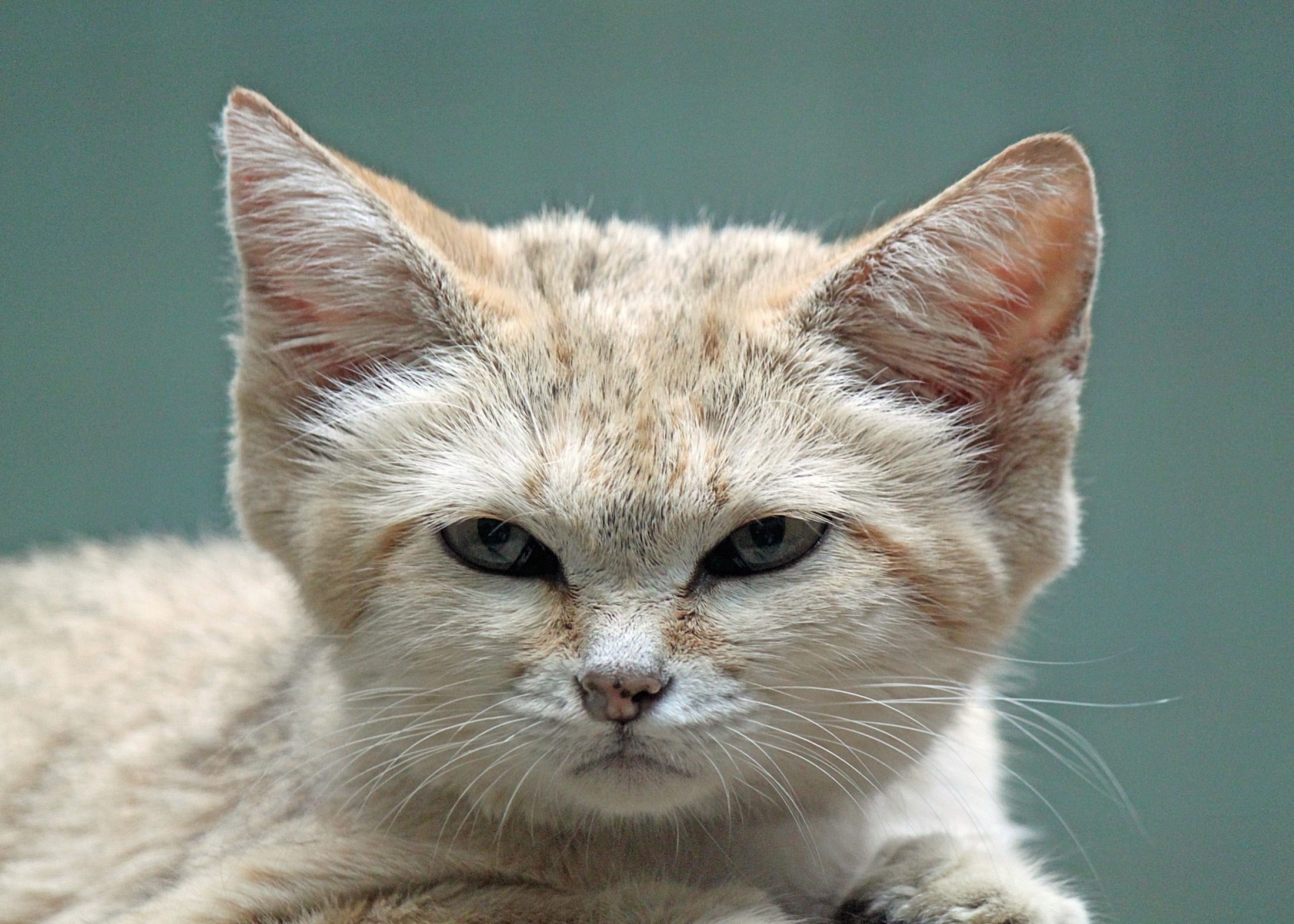
Captive image · Zoological Garden Berlin · Germany
Meet the cat
Sand cat
Felis margarita
Furred feet, pale camouflage and extreme heat tolerance make life in true desert possible.
ConservationLeast ConcernLC
Relative sizeSmall
ActivityNocturnal
LineageDomestic cat
Weight1.35–3.4 kg
Body length39–52 cm
Tail length22–31 cm
The only cat centered on true desert
A sand cat survives extremes by disappearing beneath them.
Sand cats live in deserts where shade is scarce, surface water may be absent, and temperatures swing dramatically between day, night, and season. Their solution is not to endure every extreme in the open, but to retreat underground and emerge when the desert becomes workable.
Large, low-set ears help detect prey moving under sand. Dense fur covers the footpads, insulating them from heat and cold while softening tracks. Pale camouflage finishes an animal that can become remarkably difficult to see simply by crouching still.
Habitat and range
True desert still needs vegetation, prey, and stable ground.
The sand cat has a discontinuous range across North Africa, the Arabian Peninsula, and parts of Southwest and Central Asia. It uses sandy and rocky deserts, gravel plains, wadis, stabilized dunes, and even volcanic fields.
Bare, shifting sand is often poor habitat. Shrubs stabilize den sites and concentrate the rodents, birds, reptiles, and insects on which sand cats depend. The desert may look open, but usable habitat is finely patterned.
How it belongs
Built for this particular world.
Fur between every step
Ears tuned underground
A burrow as climate control
The conservation reality
A wide range can still be a chain of isolated places.
The sand cat is classified as Least Concern, but no reliable range-wide population estimate or trend exists. Regional populations can be rare, declining, or separated by large gaps with little survey coverage.
- Desert habitat degradation and fragmentation
- Roads, settlements, agriculture, and off-road recreation
- Overgrazing and reduced prey
- Free-ranging cats and dogs
- Disease, traps, poison, and fences
- Pet trade and human disturbance
- Major gaps in distribution and population knowledge
What effective work looks like
Conserve the living desert, not an imagined emptiness.
Useful action protects the shrubs, soils, prey, and quiet spaces that make desert habitat functional, while improving surveys across the enormous gaps in current knowledge.
Survey across borders
Standardized camera trapping, tracking, and shared records can reveal whether distribution gaps reflect absence or simply a lack of looking.
Protect desert structure
Managing grazing, vehicle access, development, and disturbance preserves vegetation, dens, and prey-rich microhabitats.
Reduce direct mortality
Dog management, safer fencing, anti-trafficking work, and alternatives to indiscriminate traps and poison address preventable losses.
From hope to participation
A desert becomes easier to protect once people can see that it is alive.
Zoo-EV will connect the sand cat to credible field surveys and desert stewardship rather than to exotic-pet fascination. Participation starts by sharing an accurate animal: a specialized wild hunter, not a miniature pet built for sand.
Participate in the missionScientific sources, review, and image provenance
Scientific review: August 22, 2026. This account will continue to change when stronger evidence or updated specialist assessments become available.
- IUCN SSC Cat Specialist Group · Sand cat
- Arabian sand cat status review
- Image: H. Zell · captive · Zoological Garden Berlin · Germany · CC BY-SA 3.0