
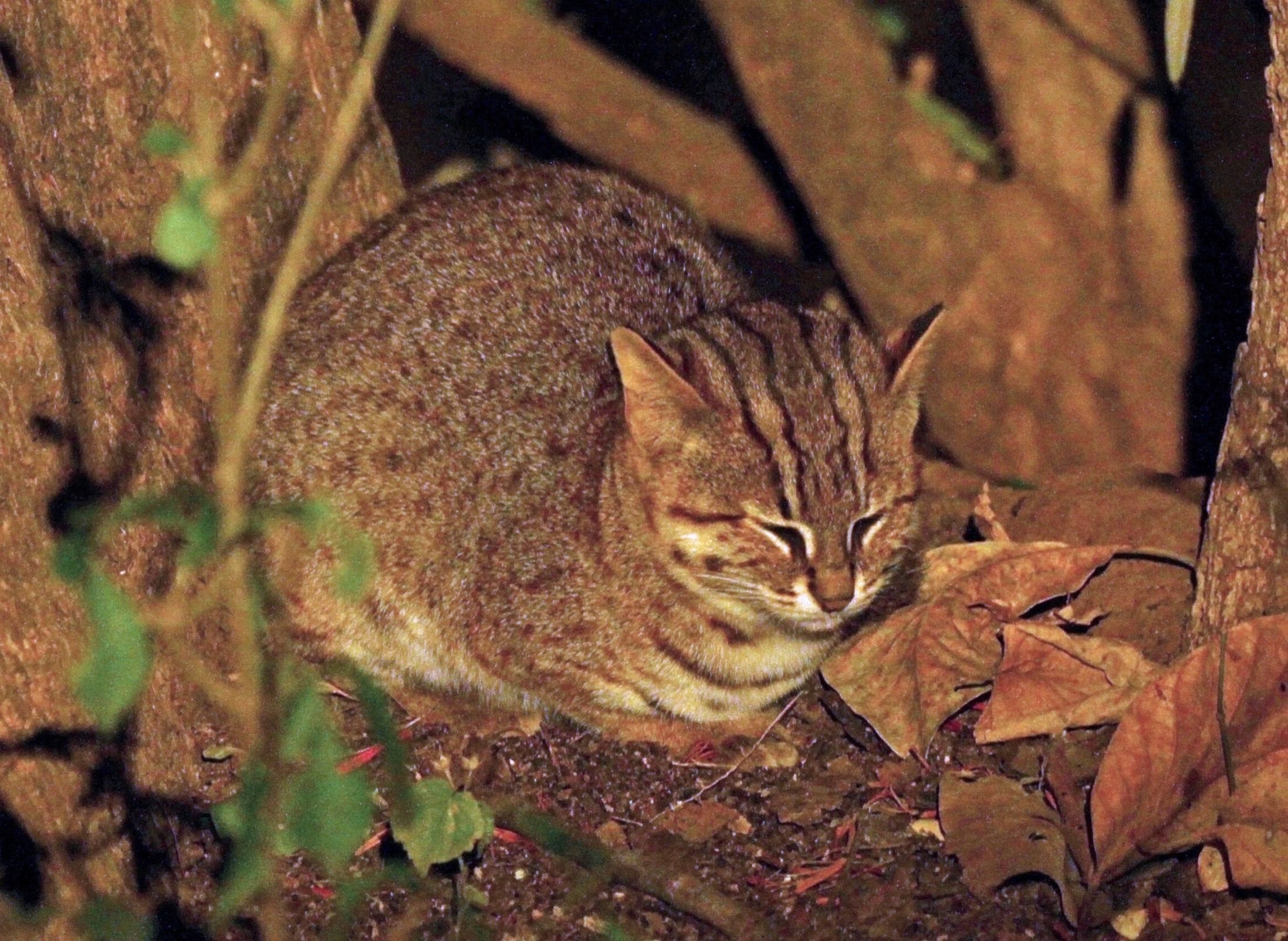
Wild image · India · Night observation
Meet the cat
Rusty-spotted cat
Prionailurus rubiginosus
Among the world’s smallest cats, yet an agile hunter in forest, scrub and farmland mosaics.
ConservationNear ThreatenedNT
Relative sizeSmall
ActivityNocturnal
LineageLeopard cat
Weight1–2 kg
Body length35–48 cm
Tail length20–25 cm
Half the size of a domestic cat
Tiny is a measurement—not a limitation.
The rusty-spotted cat can weigh barely one kilogram, yet it climbs quickly, hunts on the ground, and has been seen pouncing from branches onto prey. When danger arrives, the same agility carries it into trees, rock gaps, dense thickets, or caves.
Its soft grey-fawn coat is washed with rust-colored spots and lines. Large eyes suit nocturnal hunting, while black foot soles and a tail only about half the body length distinguish its compact silhouette from its leopard-cat relatives.
Habitat and range
Forest, scrub, rock—and sometimes an attic above a field.
Rusty-spotted cats occur in India, Nepal, and Sri Lanka across dry and moist forest, thorn scrub, grassland, rocky country, and arid coastal habitat. Dense vegetation and stone cover seem especially important.
They also appear in tea plantations, sugarcane, coconut and paddy landscapes, reforested ground, village edges, and even house attics. These records show flexibility, but scientists still do not know whether heavily cultivated landscapes can support populations over the long term.
How it belongs
Built for this particular world.
Small enough to use overlooked shelter
Eyes made for the night shift
A climber with a ground-hunter’s menu
The conservation reality
Living near people is not the same as being safe around them.
The rusty-spotted cat is Near Threatened and described as widespread but nowhere common. There is no reliable population estimate, and infrequent records leave its distribution, trend, and tolerance of human-altered land unresolved.
- Habitat loss and fragmentation
- Large-scale irrigated agriculture
- Urban, industrial, mining, and solar development
- Poultry-related persecution
- Road mortality and killing by dogs
- Prey loss, disease, and possible hybridization
What effective work looks like
Study the places where wild habitat and daily life meet.
Protected areas matter, but this cat repeatedly appears in farms and settlements. Conservation needs to learn which mixed landscapes function as habitat and which are ecological traps.
Build a reliable distribution picture
Verified sightings, camera traps, genetics, and community reporting can fill major gaps across India, Nepal, and Sri Lanka.
Make harvests and homes safer
Checking sugarcane before cutting, protecting poultry, managing dogs, and retaining scrub or rock cover can reduce avoidable deaths.
Measure long-term persistence
Repeated surveys outside reserves can distinguish breeding populations from occasional cats passing through cultivated land.
From hope to participation
The smallest cat can reveal the largest gaps in what we know.
Zoo-EV will highlight research and coexistence work that takes local observations seriously. Participation can turn a fleeting village-edge sighting into evidence that helps protect a poorly known species.
Participate in the missionScientific sources, review, and image provenance
Scientific review: August 23, 2026. This account will continue to change when stronger evidence or updated specialist assessments become available.
- IUCN SSC Cat Specialist Group · Rusty-spotted cat
- Cat Conservation Compendium · Rusty-spotted cat
- Image: David V. Raju · wild · India · Night observation · CC BY-SA 4.0