
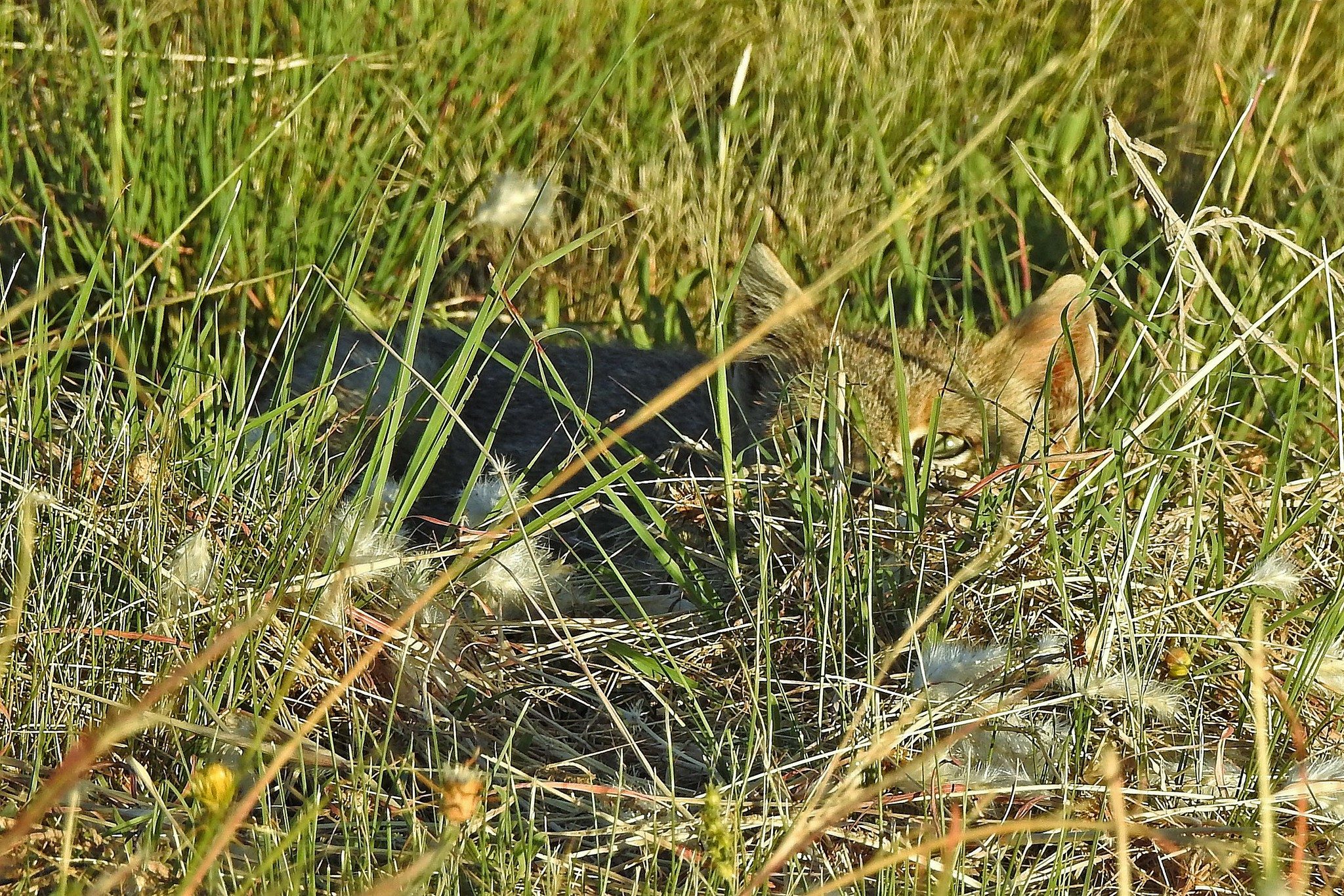
Wild image · Argentina · Southern pampas-cat form
Meet the cat
Pampas cat
Leopardus colocola
A variable South American cat associated with open country from low grasslands to the Andes.
ConservationNear ThreatenedNT
Relative sizeSmall
ActivityNocturnal
LineageOcelot
Weight3–4 kg
Body length42–79 cm
Tail length22–33 cm
One name. An astonishing number of appearances.
A pampas cat can look striped, spotted, nearly plain—or dressed for a different species.
Across South America, pampas cats vary from yellow-white to grey-brown, with coats that may be plain, spotted, or strongly striped. Some grow hair up to seven centimeters long, forming a dark crest along the back that can rise when the cat is alarmed.
Variation this dramatic has repeatedly changed the taxonomy. Zoo-EV follows the Cat Specialist Group’s broad species treatment while acknowledging that other authorities divide the complex. In the high Andes, a pampas cat can even resemble the rarer Andean mountain cat; the pampas cat’s pink nose is one of the most useful visible clues.
Habitat and range
The name says pampas. The cat’s map says much more.
Pampas cats range through Argentina, Bolivia, Brazil, Chile, Ecuador, Paraguay, Peru, Uruguay, and marginally Colombia. They use pampas grassland, puna, high Andes, shrub-steppe, dry woodland, thorn forest, floodplain, mangrove, swamp, rocky country, and cold semi-desert.
They are predominantly cats of open country and can occur from near sea level to about 5,000 meters. Unlike some adaptable small cats, they do not appear to tolerate plantations, intensive agriculture, and settled edges particularly well.
How it belongs
Built for this particular world.
A wardrobe shaped by place
A crest hidden in the coat
A schedule that changes with habitat
The conservation reality
A vast range contains rare, isolated, and possibly disappearing populations.
The broad pampas cat is classified as Near Threatened, but reliable status information remains scarce. Some regional populations are considered Vulnerable, and the cat may already be absent from parts of the grassland that gave it its name.
- Grassland and shrubland conversion
- Oil extraction, agriculture, and livestock pressure
- Declining prey
- Retaliatory and cultural killing
- Road mortality and attacks by dogs
- Taxonomic and population-data uncertainty
What effective work looks like
Protect populations before every name is settled.
Taxonomic uncertainty changes how conservation units are drawn, but it does not make habitat loss or local disappearance less urgent.
Resolve the complex range-wide
Genetics, morphology, and geographically balanced sampling can clarify whether conservation is dealing with one variable species or several.
Survey the forgotten open lands
Camera traps, records, and long-term monitoring are needed beyond forests and famous reserves, especially in grassland and dry-country mosaics.
Work with local meaning
Coexistence programs should respect the cat’s cultural significance while reducing poultry losses, dog attacks, road deaths, and hunting.
From hope to participation
Uncertainty is a reason to look closer, not look away.
Zoo-EV will keep the pampas cat’s treatment transparent and dated. Participation can help build the field evidence needed to protect distinct populations before scientific disagreement is fully resolved.
Participate in the missionScientific sources, review, and image provenance
Scientific review: August 23, 2026. This account will continue to change when stronger evidence or updated specialist assessments become available.
- IUCN SSC Cat Specialist Group · Pampas cat
- 2017 revised taxonomy of Felidae
- Image: Hugo Hulsberg · wild · Argentina · Southern pampas-cat form · CC0 1.0