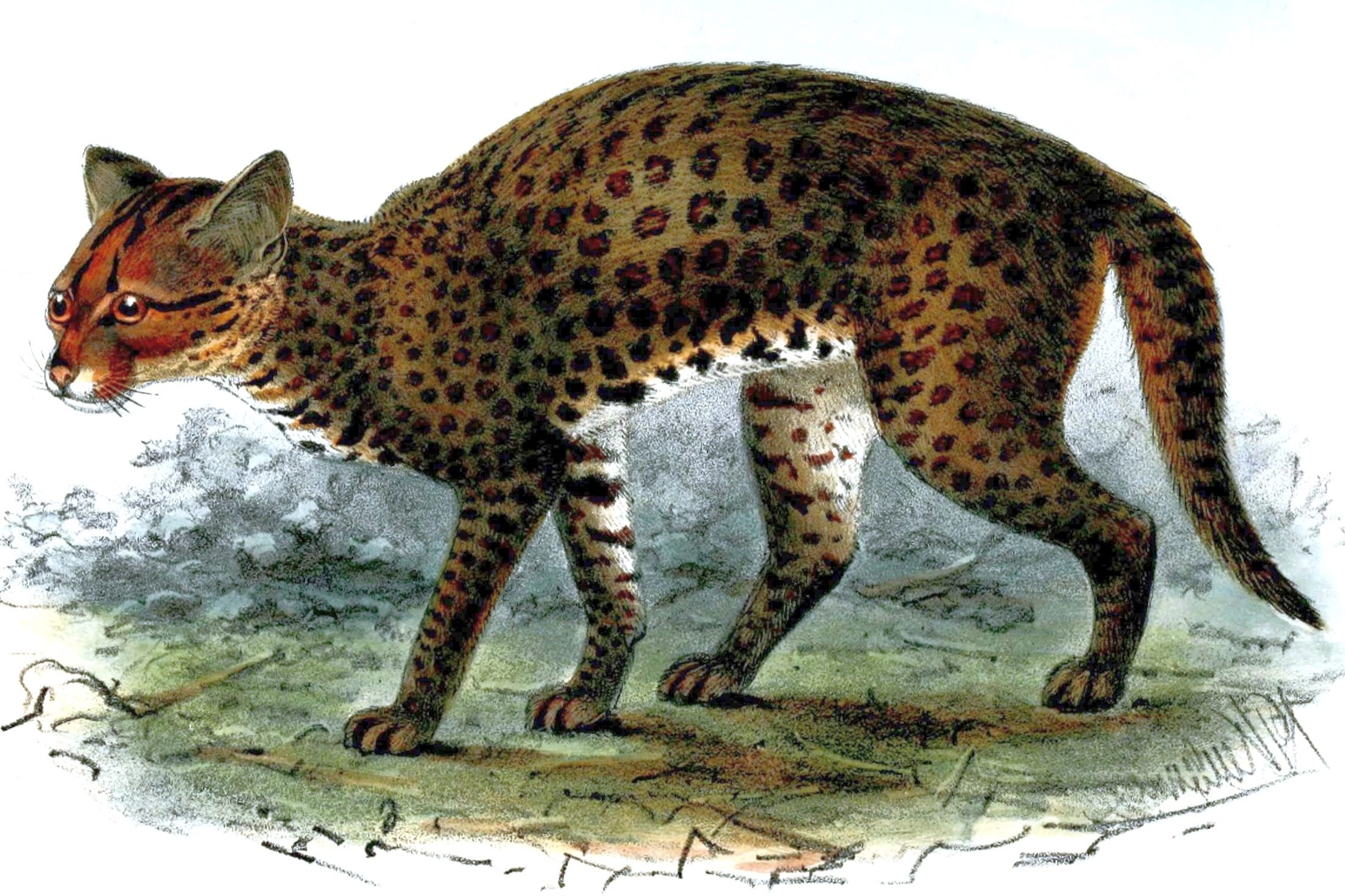
Archive illustration · Proceedings of the Zoological Society of London · 1873
Meet the cat
African golden cat
Caracal aurata
A secretive forest cat whose coat can range from golden-red to grey and nearly black.
ConservationVulnerableVU
Relative sizeMedium
ActivityNocturnal
LineageCaracal
Weight7–16 kg
Body length65–90 cm
Tail length28–35 cm
The golden cat that is not always golden
Same name. Similar forest. Entirely different branch of the cat family.
The African and Asian golden cats look like relatives, but they are not. Africa’s golden cat belongs beside the caracal and serval; the Asian species belongs with the marbled cat and Bornean bay cat. Similar forest lives shaped a similar solution—an elegant case of convergent evolution.
Even the name understates the variety. An African golden cat may be reddish, grey, plainly colored, heavily spotted, or nearly black. After the species had been known to science for almost two centuries, the first photograph of a living wild individual was not recorded until 2002.
Habitat and range
A forest cat—but not only a pristine-forest cat.
African golden cats occur through the equatorial forests of West and Central Africa, from Senegal across the Congo Basin to Uganda. Moist lowland forest is central to their range, while records also come from montane forest, bamboo forest, coastal forest, wooded savanna, and riverine mosaics.
They can use secondary and selectively logged forest where dense undergrowth and rodents remain. That flexibility matters, but it should not be mistaken for immunity: roads, fragmentation, hunting, and empty understories can turn standing trees into unusable habitat.
How it belongs
Built for this particular world.
A coat with more than one answer
Compact power under the canopy
Opportunity in the understory
The conservation reality
The forest can disappear one road, one snare, and one empty patch at a time.
The African golden cat remains Vulnerable. It is rarely seen, poorly studied, and estimated to have lost roughly 44% of its former known range as forest conversion and hunting reshape equatorial Africa.
- Deforestation and agricultural conversion
- Roads, mining, and infrastructure
- Cable snares set for bushmeat
- Loss of prey through hunting
- Fragmented forest connections
- Little field data across much of the range
What effective work looks like
Protect the cat by protecting what happens beneath the canopy.
Forest cover alone is not enough. Conservation must keep habitat connected, reduce indiscriminate hunting, and build a much clearer picture of where populations persist.
Fill the camera-trap gaps
Carefully designed surveys can map distribution, compare forest types, and establish reliable density and trend estimates.
Remove snares and reduce bushmeat pressure
Community partnerships, patrols, and livelihood alternatives protect both the cat and the prey base on which it depends.
Keep forest mosaics connected
Planning around roads, farms, mines, and logged concessions can preserve movement between remaining strongholds.
From hope to participation
A rare camera-trap frame can become evidence—not just an extraordinary image.
Zoo-EV will help turn scattered records into stories that support field surveys, snare reduction, and connected forest. Participation means making one of Africa’s least-seen cats harder to overlook.
Participate in the missionScientific sources, review, and image provenance
Scientific review: August 23, 2026. This account will continue to change when stronger evidence or updated specialist assessments become available.
- IUCN SSC Cat Specialist Group · African golden cat
- Cat Conservation Compendium · African golden cat
- Image: John Gerrard Keulemans · archive illustration · Proceedings of the Zoological Society of London · 1873 · Public domain