
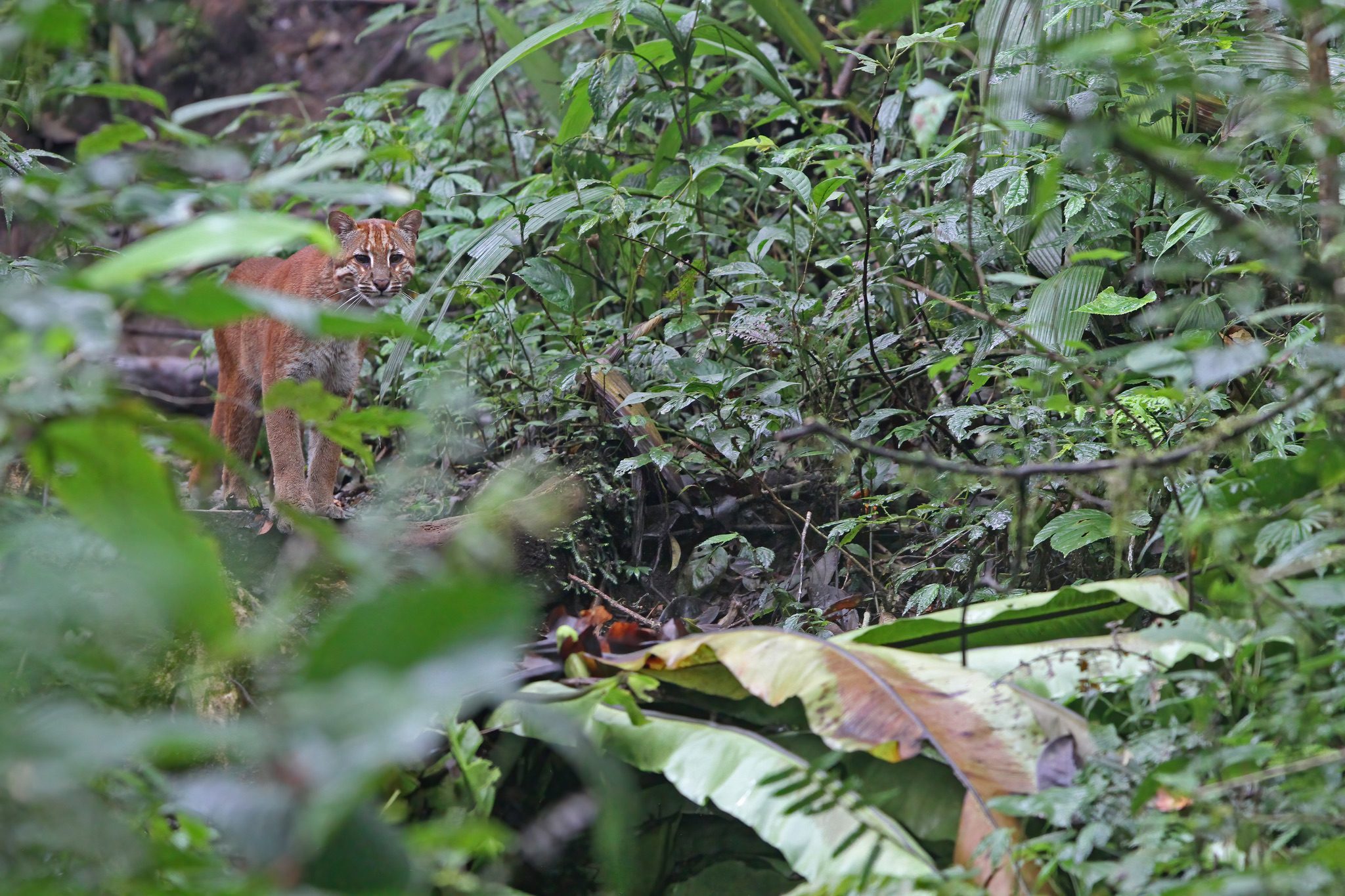
Wild image · Kerinci Seblat · Indonesia
Meet the cat
Asian golden cat
Catopuma temminckii
A muscular forest cat with coats ranging from golden to grey, spotted and melanistic.
ConservationVulnerableVU
Relative sizeMedium
ActivityFlexible
LineageBay cat
Weight9–16 kg
Body length71–105 cm
Tail length40–56 cm
One cat. A whole wardrobe.
Golden is only one of the options.
An Asian golden cat may be golden-red, dark brown, grey, black, lightly spotted, or covered in rosettes—the spectacular form researchers call the ‘ocelot morph.’ Scientists do not yet know whether geography reliably predicts which coat appears where.
Color can change dramatically, but the face keeps a clue: white lines edged in dark run across the cheeks, from the nose toward the eyes, and over the crown. The resemblance to Africa’s golden cat is coincidence shaped by similar habitat, not close kinship.
Habitat and range
Follow the trees from tropical lowlands to the edge of the alpine world.
The Asian golden cat is closely tied to closed-canopy forest across the eastern Himalayas, southern China, mainland Southeast Asia, and Sumatra. It uses tropical, subtropical, subalpine, degraded, and regenerating forest, with occasional records in shrub, grassland, rocky country, and plantation edges.
Records range from below 100 meters to about 4,600 meters in the Himalayas, broadly following tree and shrub cover uphill. That vertical range is remarkable, but much of the remaining distribution is increasingly fragmented and concentrated in a few strongholds.
How it belongs
Built for this particular world.
A face that gives the game away
More color morphs than its name admits
No single shift owns the day
The conservation reality
A green forest can still be an empty forest.
The Asian golden cat is Vulnerable. Its range has contracted and fragmented, and camera-trap surveys show it disappearing from suitable-looking habitat—including protected areas and landscapes subjected to industrial snaring.
- Indiscriminate wire snaring
- Poaching for skins, meat, and bones
- Forest loss and degradation
- Mining, roads, and infrastructure
- Declining prey populations
- Retaliatory killing after livestock loss
What effective work looks like
Keep the forest alive below the leaves.
Existing protected areas remain essential, but boundaries alone do not stop snares or reconnect fragmented populations. Better management and cooperation across borders are immediate priorities.
Make forests genuinely snare-free
Sustained patrols, removal programs, prosecution of trafficking, and community alternatives can reduce the most immediate source of mortality.
Track a cat with many appearances
Long-term camera surveys can map color morphs, remaining strongholds, elevation use, and population change rather than treating every record in isolation.
Strengthen corridors and protected areas
Transboundary planning and better management can keep movement routes open where formal protected-area coverage is limited.
From hope to participation
Protecting forest means protecting more than a green shape on a map.
Zoo-EV will connect this cat’s irresistible variety to the fieldwork behind living forests: snare removal, repeated monitoring, and cross-border habitat protection. Wonder opens the door; participation keeps it open.
Participate in the missionScientific sources, review, and image provenance
Scientific review: August 23, 2026. This account will continue to change when stronger evidence or updated specialist assessments become available.
- IUCN SSC Cat Specialist Group · Asian golden cat
- IUCN Red List status change table · Asian golden cat
- Image: James Eaton · wild · Kerinci Seblat · Indonesia · CC0 1.0