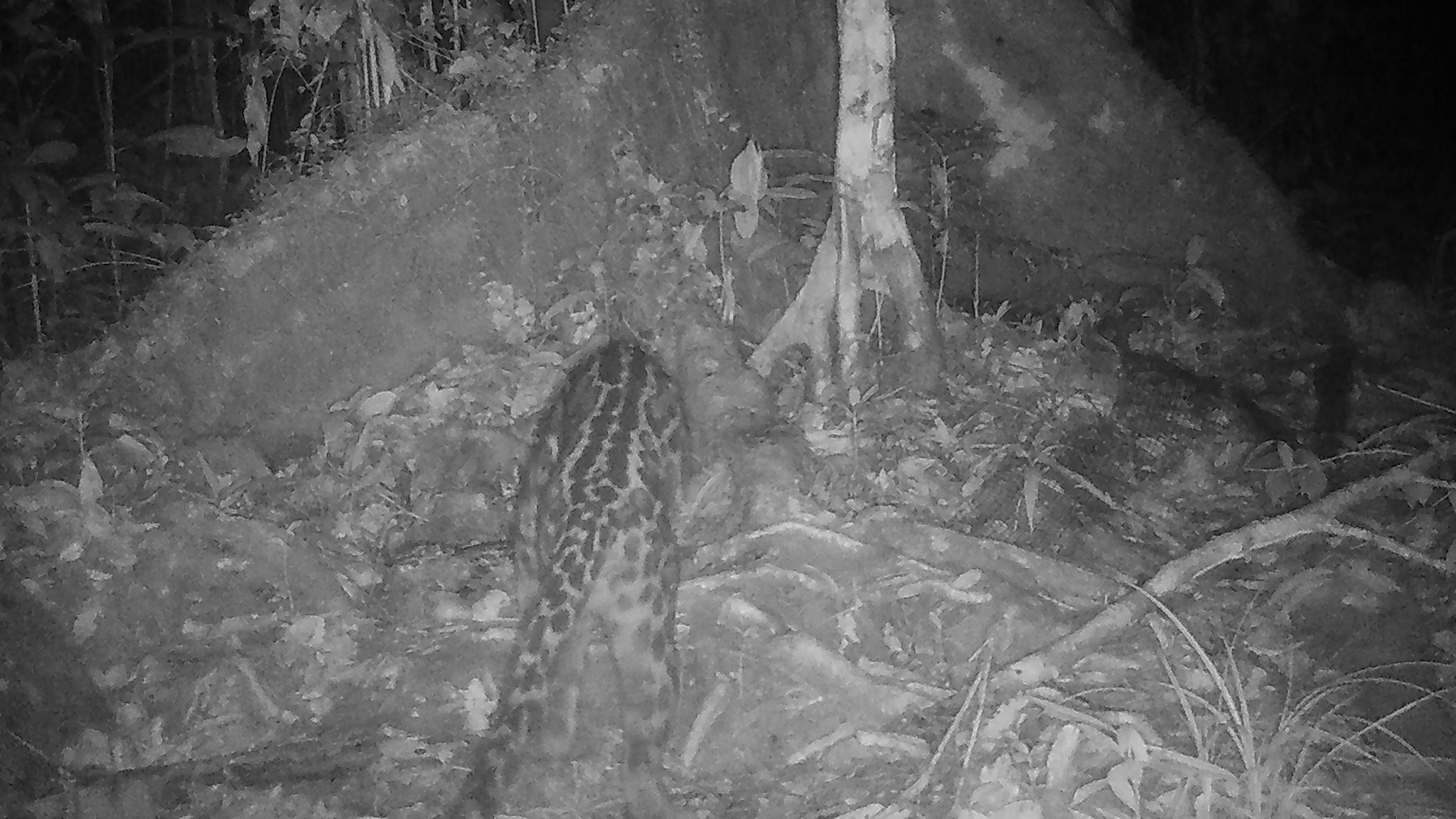
Wild image · Central Kalimantan · Indonesia
Meet the cat
Sunda clouded leopard
Neofelis diardi
An island forest cat with exceptionally long canine teeth and a tail built for balance.
ConservationVulnerableVU
Relative sizeMedium
ActivityNocturnal
LineagePanthera
Weight11–25 kg
Body length60–108 cm
Tail length61–91 cm
A species hiding inside a familiar name
The camera trap did not discover a new cat. Genetics taught us to see it.
For generations, the clouded leopards of Borneo and Sumatra were grouped with those on the Asian mainland. DNA, chromosomes, skulls, teeth, and coat patterns eventually revealed about 1.4–2.9 million years of separate evolution—enough difference for the island cat to be recognized as its own species.
The grainy infrared frame above is not a compromise. It is an honest glimpse of how a secretive forest cat becomes known: one remote camera, one passing animal, one piece of evidence at a time.
Habitat and range
Two islands hold its entire living world.
The Sunda clouded leopard occurs only on Borneo and Sumatra, where two recognized subspecies occupy different islands. It uses primary lowland and hill forest, submontane forest, logged forest, mangroves, and peat swamp.
Some disturbed forest can still support the species, but oil-palm plantations generally cannot. On Sumatra it appears more common in hill and mountain forest, while on Borneo it also uses lowlands where no tiger competes for the same landscape.
How it belongs
Built for this particular world.
Canines from another age
A tail almost as long as the cat
At home above and below
The conservation reality
A forest cat cannot follow when forest becomes plantation.
The Sunda clouded leopard is Vulnerable and declining; both island subspecies are assessed as Endangered. The range-wide estimate of roughly 4,500 mature animals remains uncertain because so little of the species’ ecology has been measured.
- Rapid forest loss and fragmentation
- Oil-palm and agricultural expansion
- Snares set for wildlife
- Illegal trade in skins and body parts
- Depletion of wild prey
- Rare retaliation after livestock loss
- Major gaps in field knowledge
What effective work looks like
Connect the forests between the photographs.
No single protected area is thought large enough to support a viable population indefinitely. Conservation must keep forest blocks connected while removing the direct pressures that follow roads and forest conversion.
Keep forest corridors standing
Connected protected areas, logging concessions, and community forests allow movement and gene flow across landscapes too large for one reserve.
Remove snares and disrupt trade
Patrols, intelligence-led enforcement, and work with local communities reduce both targeted killing and the indiscriminate traps set for other wildlife.
Turn encounters into evidence
Long-term camera trapping, genetic sampling, and prey surveys can replace broad assumptions with island-specific population and habitat knowledge.
From hope to participation
Sometimes discovery looks like two bright eyes in a dark frame.
Zoo-EV will use field evidence without pretending every wild-cat photograph must be polished. Participation can help researchers keep cameras running, forests connected, and a recently recognized species visible to the world.
Participate in the missionScientific sources, review, and image provenance
Scientific review: August 23, 2026. This account will continue to change when stronger evidence or updated specialist assessments become available.
- IUCN SSC Cat Specialist Group · Sunda clouded leopard
- 2017 revised taxonomy of Felidae
- Image: Justin Philbois · wild · Central Kalimantan · Indonesia · CC0 1.0