Wild image · Narok · Kenya
Meet the cat
Cheetah
Acinonyx jubatus
Built for acceleration, the cheetah trades climbing power for extraordinary speed.
ConservationVulnerableVU
Relative sizeLarge
ActivityDiurnal
LineagePuma
Weight23–65 kg
Body length113–140 cm
Tail length60–84 cm
The big-looking cat on the small-cat side
Its closest living relatives are the puma and jaguarundi—not the leopard.
The cheetah’s size and spots invite comparison with Panthera cats, but its family branch leads instead to the puma and the slender jaguarundi. It cannot roar, and nearly every part of its body has been reshaped around acceleration, grip, steering, oxygen, and recovery.
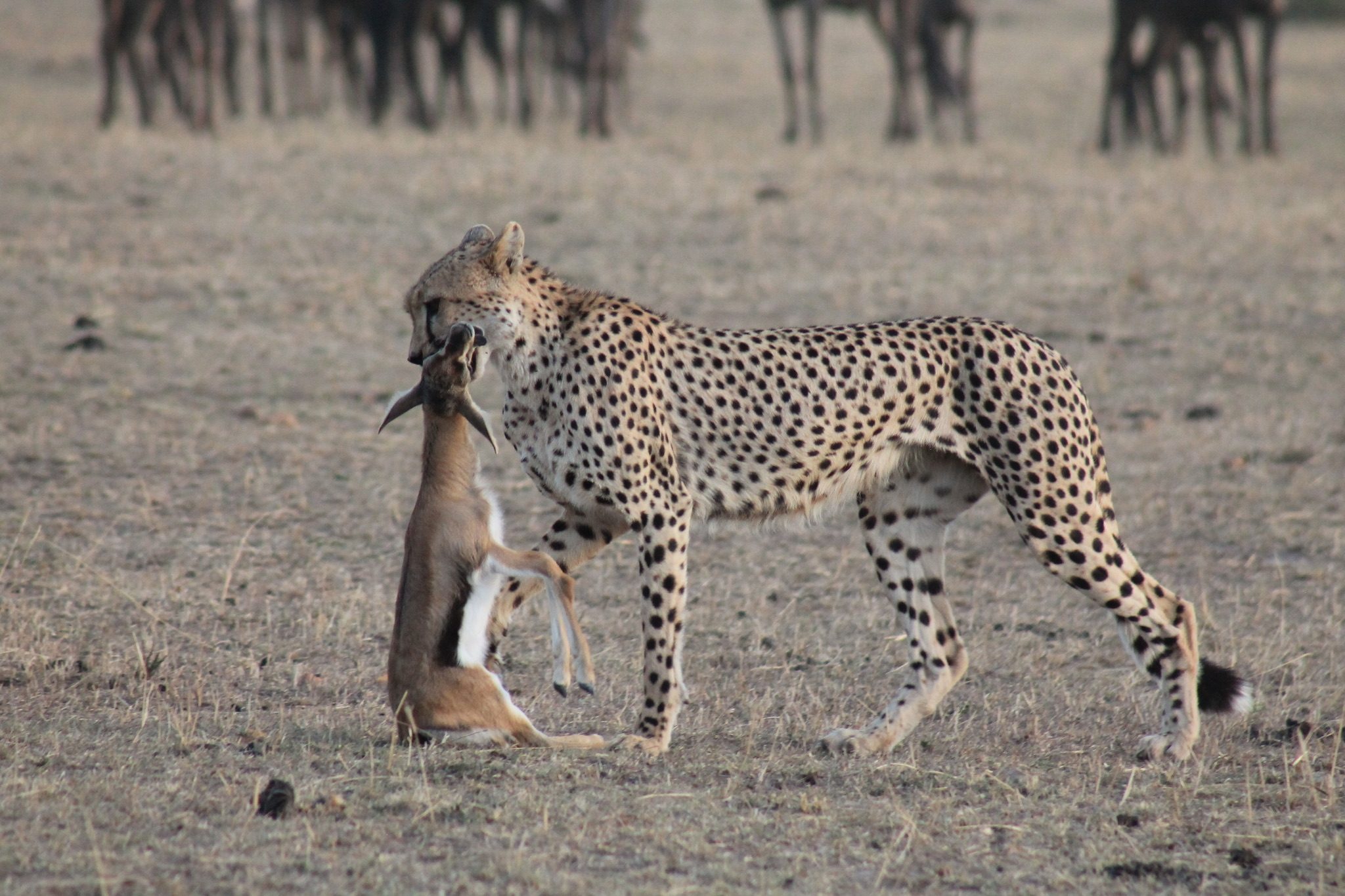
Speed is only useful when it can be turned into a meal. The chase is short, prey can change direction, and a cheetah may lose its catch to larger carnivores. The photograph above shows the instant after athletic spectacle becomes survival.
Habitat and range
Open country needs cover—and far more room than it appears to.
Cheetahs occupy grassland, savanna, dry woodland, shrubland, semi-desert, and mountain desert. Most remain in eastern and southern Africa; tiny, Critically Endangered populations survive in northwest Africa and Iran.
Females and nonterritorial males can range across hundreds or even thousands of square kilometers. About seventy-seven percent of known range lies outside protected areas, making farms and community lands central rather than peripheral to conservation.
How it belongs
Built for this particular world.
Claws that behave like cleats
A spine that lengthens every stride
The tail steers the chase
The conservation reality
The fastest cat cannot outrun a shrinking map.
The cheetah is Vulnerable, with a tentative estimate of about 6,517 mature animals across thirty-three subpopulations. Two-thirds of those subpopulations hold fewer than one hundred mature animals.
- Habitat loss and fragmented range
- Declining gazelles and other prey
- Retaliation over perceived livestock loss
- Illegal trade in live cubs
- Roads and infrastructure
- Snares and bushmeat hunting
- Competition with larger carnivores
- Poor tourism practices around hunts and cubs
What effective work looks like
Conservation has to move at landscape scale.
Most reserves are too small for a viable cheetah population. Survival depends on land-use planning and coexistence across the ranches, farms, and community conservancies surrounding them.
Keep working lands permeable
Connected open habitat, prey-friendly management, and compatible fencing let wide-ranging cats move across property lines.
Base conflict response on evidence
Livestock protection and verified loss data can replace broad blame with targeted, practical prevention.
Stop the live-cub trade
Regional enforcement, demand reduction, rescue capacity, and protection of mothers address a trade with exceptionally high mortality.
From hope to participation
Admire the sprint. Stay for the landscape problem.
Zoo-EV will use the cheetah’s speed as the invitation, then make room, coexistence, and illegal trade impossible to miss. Participation supports the people and networks working across the spaces no single reserve can contain.
Participate in the missionScientific sources, review, and image provenance
Scientific review: August 23, 2026. This account will continue to change when stronger evidence or updated specialist assessments become available.
- IUCN SSC Cat Specialist Group · Cheetah
- Range Wide Conservation Program for Cheetah and African Wild Dogs
- Image: Paula Zermoglio · wild · Narok · Kenya · CC0 1.0