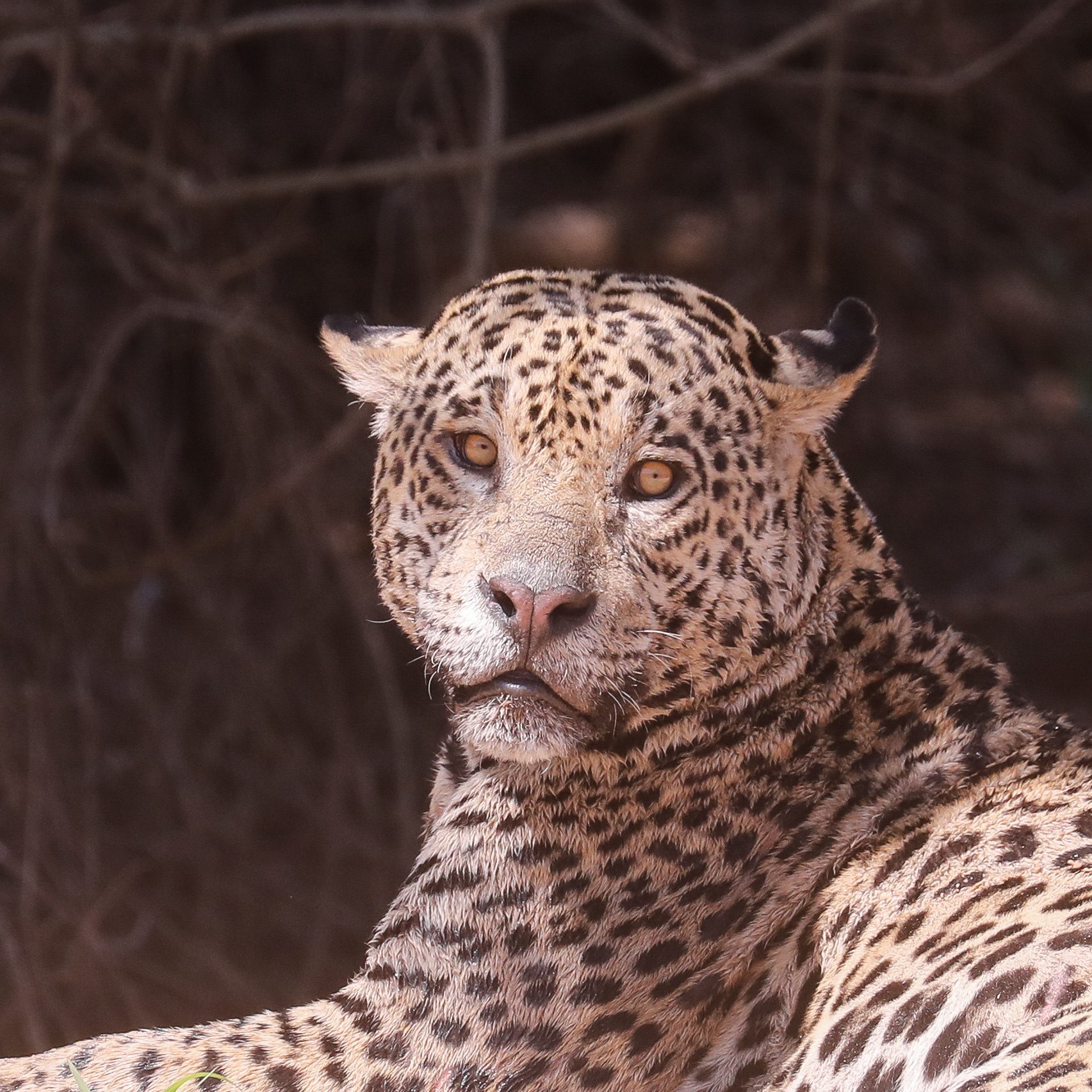
Wild image · Poconé, Mato Grosso · Brazil
Meet the cat
Jaguar
Panthera onca
The largest cat in the Americas, with a crushing bite and a close relationship with water.
ConservationNear ThreatenedNT
Relative sizeLarge
ActivityFlexible
LineagePanthera
Weight36–148 kg
Body length110–170 cm
Tail length44–80 cm
Spots inside the spots
A jaguar is not a leopard with a heavier accent.
Jaguar rosettes are generally larger than a leopard’s and often contain one or more black dots. Under that pattern is an unusually stocky cat with a broad head, short powerful limbs, and jaws capable of piercing a prey animal’s skull.
It is also the only living Panthera cat native to the Americas. Genetic and morphological work recognizes one species across the range, with four partially isolated geographic groups rather than named subspecies.
Habitat and range
Follow the water—but do not stop at rainforest.
Jaguars range from Mexico through Central America and South America to northern Argentina, with occasional dispersers reaching the southwestern United States. Tropical forest and great wetlands such as the Pantanal are strongholds.
They also use mangroves, wet savanna, dry Chaco woodland, conifer forest, and high country. Water is a recurring thread: jaguars swim readily and hunt capybaras, fish, turtles, and caimans as well as terrestrial prey.
How it belongs
Built for this particular world.
A bite built for armor
Water is hunting ground
Read the rosette’s center
The conservation reality
Amazon abundance can hide collapse everywhere else.
The jaguar is Near Threatened and occupies about half of its historic range. Amazonia holds an estimated eighty-nine percent of the global population; every one of the other identified subpopulations is assessed as Endangered or Critically Endangered.
- Forest and wetland conversion
- Broken corridors and isolated populations
- Retaliation after cattle losses
- Declining wild prey
- Poaching and illegal trade
- Roads, dams, fires, and development
- Extirpation at northern and southern range edges
What effective work looks like
Keep a corridor alive from Mexico to Argentina.
Jaguars do not need untouched wilderness at every step, but they do need connected landscapes with prey, cover, and people willing and able to prevent conflict.
Connect Jaguar Conservation Units
Ground-truthed corridors between strongholds maintain dispersal and genetic exchange across national boundaries.
Prevent cattle losses
Better herd supervision, calving practices, night protection, and rapid verification reduce both economic loss and retaliatory killing.
Protect rivers, wetlands, forest, and prey
Landscape conservation and effective enforcement preserve the entire hunting system rather than only the cat at its top.
From hope to participation
A jaguar corridor is a continental story made from local choices.
Zoo-EV will connect this famous cat to ranchers, wetlands, river forests, prey, and cross-border teams. Participation helps keep the spaces between protected areas passable instead of leaving isolated spots on a map.
Participate in the missionScientific sources, review, and image provenance
Scientific review: August 23, 2026. This account will continue to change when stronger evidence or updated specialist assessments become available.
- IUCN SSC Cat Specialist Group · Jaguar
- Panthera · Jaguar Corridor Initiative
- Image: Thomas Galewski · wild · Poconé, Mato Grosso · Brazil · CC BY 4.0