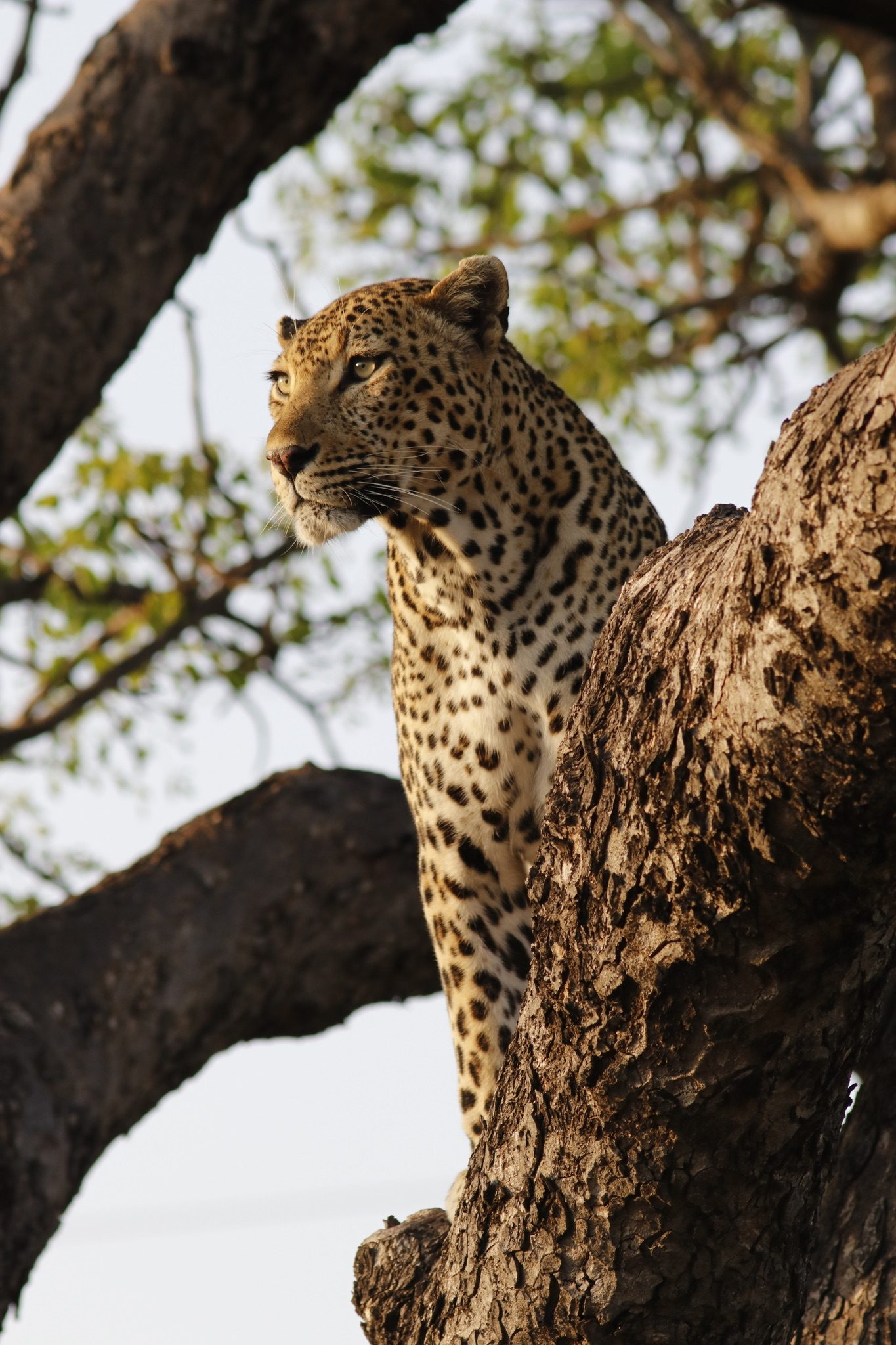
Wild image · Mpumalanga · South Africa
Meet the cat
Leopard
Panthera pardus
One of the most adaptable big cats, surviving across an extraordinary range of landscapes.
ConservationVulnerableVU
Relative sizeLarge
ActivityNocturnal
LineagePanthera
Weight17–90 kg
Body length91–191 cm
Tail length51–101 cm
The adaptable one
A leopard can live almost anywhere. That does not mean it can survive everything.
Rainforest, savanna, desert, mountain, mangrove, tea garden, and the edges of cities all appear on the leopard’s map. Its coat shifts with those places too: pale in dry country, richly golden in rainforest, long-haired in cold mountains, and sometimes melanistic where humid forest favors darkness.
Adaptability has limits. Between 2016 and 2023, the leopard’s known occupied range still fell by about eleven percent. A species can persist beside people in one landscape and quietly vanish from another.
Habitat and range
The widest big-cat habitat is now a patchwork.
Leopards remain across much of sub-Saharan Africa and scattered parts of Arabia, Southwest and Central Asia, the Indian subcontinent, Sri Lanka, Southeast Asia, China, Java, and the Russian Far East. They occur from sea level to more than 5,000 meters in the Himalayas.
That broad outline hides dramatic regional collapse. North Africa may have lost its last leopards, Southeast Asian populations have disappeared from several countries, and many surviving Asian and West African populations are small islands.
How it belongs
Built for this particular world.
A pantry in the branches
One hunter, many menus
Rosettes change with the light
The conservation reality
The last leopard in a region can still belong to a globally Vulnerable species.
The leopard is Vulnerable after a reduction of more than thirty percent. Habitat and prey loss, conflict, trade, and poorly managed hunting combine differently across a range too large for one conservation answer.
- Habitat loss and fragmentation
- Depleted wild prey and bushmeat hunting
- Retaliatory killing and poison
- Illegal trade in skins and body parts
- Poorly managed trophy hunting
- Roads and expanding development
- Isolation and declining genetic diversity
What effective work looks like
Match conservation to the leopard’s many worlds.
An adaptable cat can recover when cover, prey, and tolerance return. The work must extend beyond reserves because many leopards live along their borders or entirely outside them.
Prevent conflict before livestock is lost
Secure enclosures, attentive herding, rapid response, and fair compensation reduce the pressure for poison and retaliation.
Protect prey and connected cover
Healthy wild ungulates, safe corridors, and habitat retained across farms and community lands support breeding rather than mere survival.
Make use and trade accountable
Strong enforcement and evidence-based, transparent management are essential wherever skins, body parts, or trophies create mortality.
From hope to participation
Adaptable is a compliment, not a conservation plan.
Zoo-EV will use the leopard to show why global labels never replace local knowledge. Participation can support coexistence, connected landscapes, and the field teams watching populations that rarely make international headlines.
Participate in the missionScientific sources, review, and image provenance
Scientific review: August 23, 2026. This account will continue to change when stronger evidence or updated specialist assessments become available.
- IUCN SSC Cat Specialist Group · Leopard
- 2017 revised taxonomy of Felidae
- Image: Karen Eichholz · wild · Mpumalanga · South Africa · CC BY 4.0