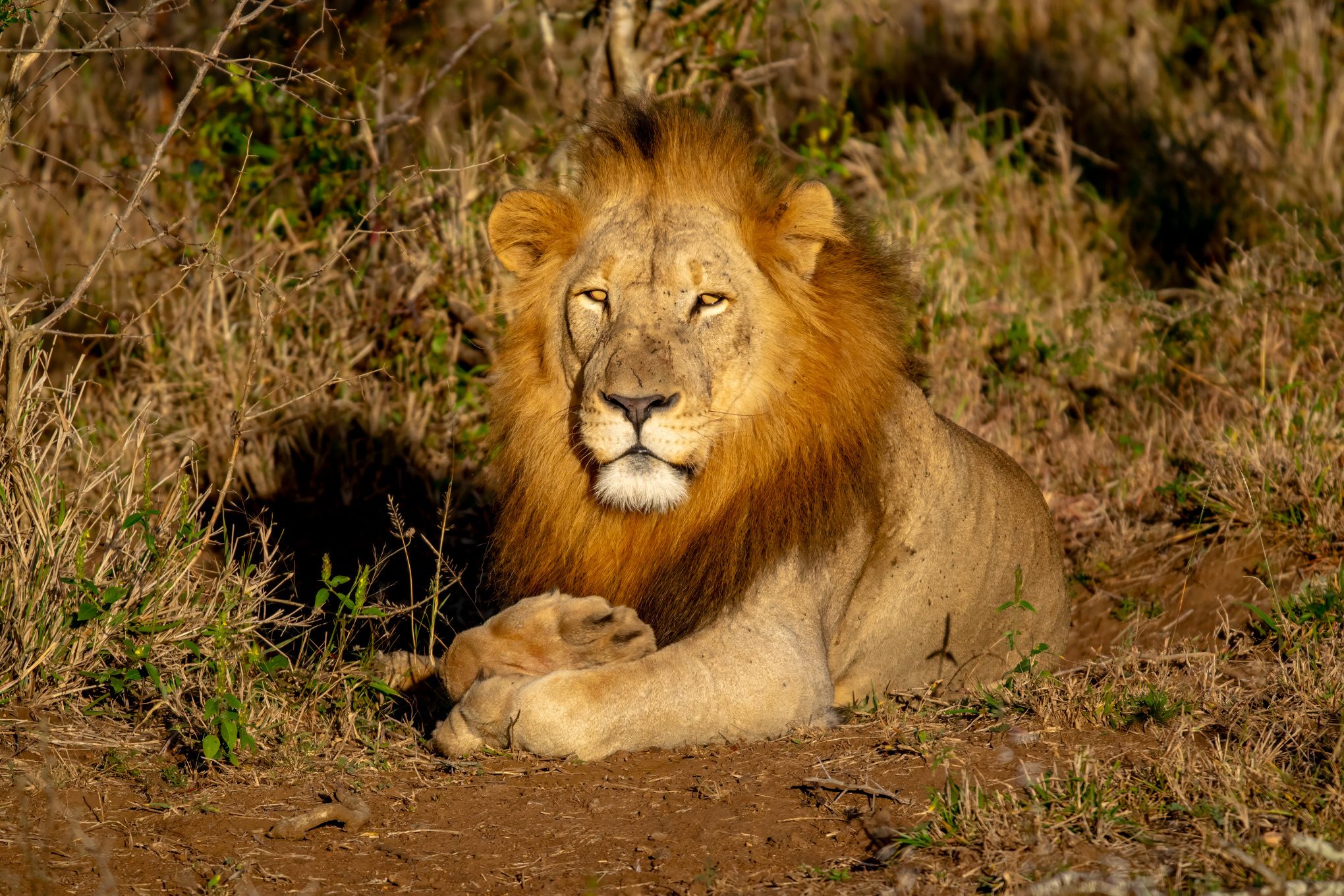
Wild image · Umkhanyakude, KwaZulu-Natal · South Africa
Meet the cat
Lion
Panthera leo
The only truly social cat, living in prides whose structure changes with place and prey.
ConservationVulnerableVU
Relative sizeLarge
ActivityFlexible
LineagePanthera
Weight110–272 kg
Body length137–250 cm
Tail length60–100 cm
The cat that made family life a strategy
A pride is not one rigid family model. It changes with land, prey, and pressure.
Lions are the most social cats, but the textbook pride is only a starting point. Related females may hunt, defend territory, give birth at similar times, and nurse one another’s cubs; males may arrive alone or in coalitions. Group size expands and contracts with prey and risk.
Even a lion’s face keeps time. Pink noses accumulate black speckles with age, while mane length and darkness reflect genetics, health, climate, and condition—not a simple rank badge.
Habitat and range
The savanna icon also belongs to forest, scrub, and desert.
Most surviving lions live in sub-Saharan Africa, using savanna, woodland, dry forest, scrub, and semi-desert. The remaining Asian population lives in and around India’s Gir landscape, where dry deciduous forest, thorn woodland, farms, villages, and livestock form one shared system.
In 2025, occupied range was estimated at just over six percent of the lion’s historical range. Many populations are small and isolated, especially in West and Central Africa; India’s recovering population remains concentrated in one landscape.
How it belongs
Built for this particular world.
Cubs raised by a neighborhood
Hunting is not a girls-only job
A mane carries information
The conservation reality
The roar travels farther than the population does.
The lion is Vulnerable and its range remains highly fragmented. Roughly 22,000–25,000 adult and subadult lions were estimated in Africa in 2025, while the northern subspecies spanning West and Central Africa and India is Endangered.
- Habitat loss and fragmentation
- Prey depletion and bushmeat trade
- Retaliatory killing after livestock loss
- Wire snares and poisoned carcasses
- Illegal body-part trade
- Poorly managed trophy hunting
- Conflict, insecurity, and weak reserve resources
- One isolated Asian population
What effective work looks like
A pride survives when the wider human community can live with it.
Lions need well-managed core areas, but coexistence outside their boundaries decides whether populations remain connected and whether local people carry an unfair share of conservation’s cost.
Keep livestock and people safer
Strong nighttime enclosures, herding support, rapid response, and compensation reduce loss and prevent indiscriminate retaliation.
Fund prey, patrols, and local benefit
Effective reserves need sustained management, while surrounding communities need tangible value from living alongside lions.
Create room for more than one stronghold
Corridors and an additional secure Asian population would reduce isolation, disease risk, and dependence on a single landscape.
From hope to participation
Living with lions is not an abstract idea for the people doing it every night.
Zoo-EV will place community safety and benefit inside the lion story, not in a footnote. Participation helps make coexistence practical while keeping the world’s most social cat connected to a future larger than one reserve.
Participate in the missionScientific sources, review, and image provenance
Scientific review: August 23, 2026. This account will continue to change when stronger evidence or updated specialist assessments become available.
- IUCN SSC Cat Specialist Group · Lion
- IUCN SSC Cat Specialist Group · African Lion Database
- Image: David Knox · wild · Umkhanyakude, KwaZulu-Natal · South Africa · CC BY-SA 4.0