
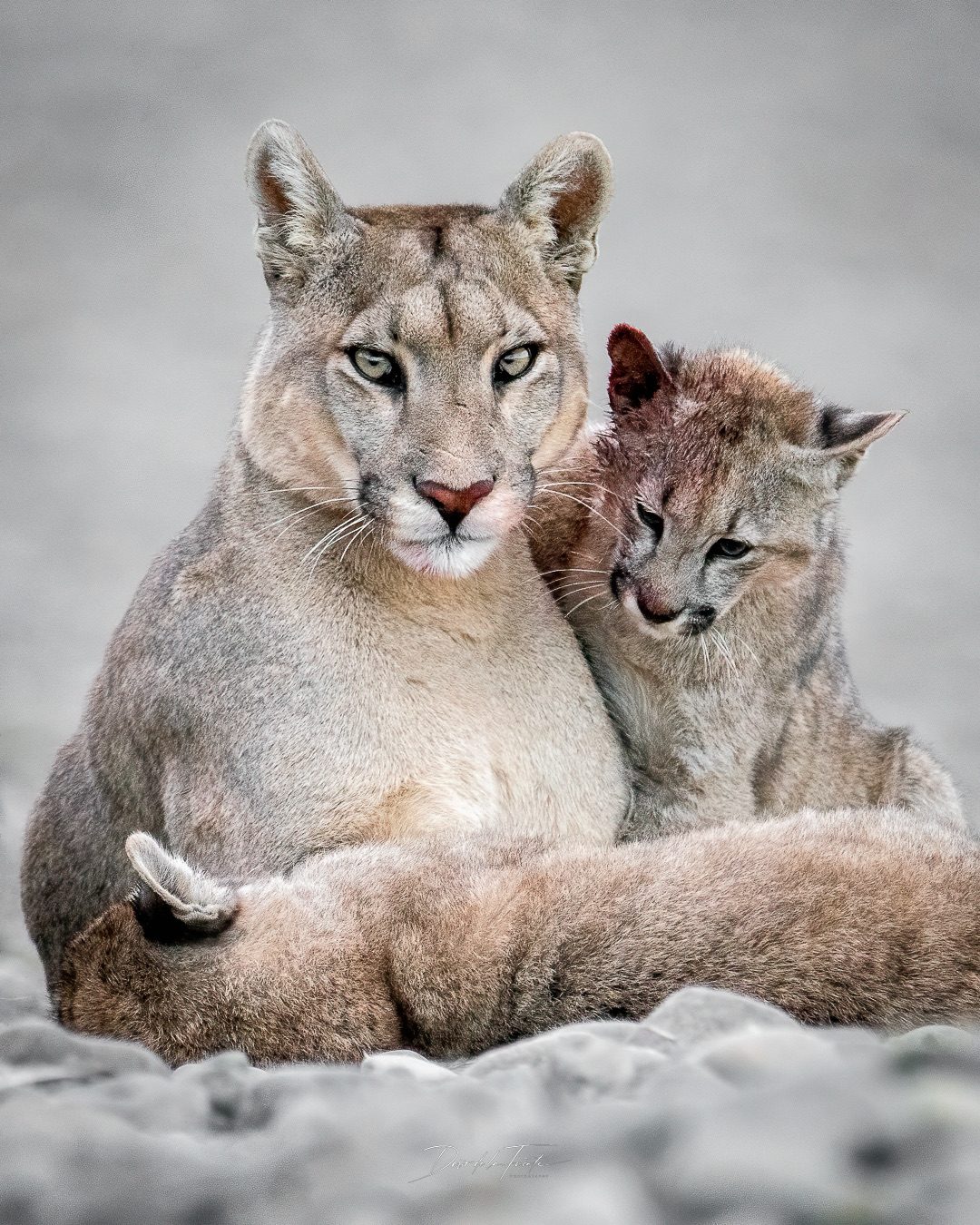
Wild image · Última Esperanza, Magallanes · Chile
Meet the cat
Puma
Puma concolor
No wild land mammal in the Americas spans a greater north-to-south range.
ConservationLeast ConcernLC
Relative sizeLarge
ActivityFlexible
LineagePuma
Weight30–80 kg
Body length100–150 cm
Tail length60–90 cm
One cat, a continent of names
Puma, cougar, mountain lion, panther: the names change. The species does not.
No native land mammal in the Western Hemisphere spans a greater north-to-south range. Along the way, people gave Puma concolor so many regional names that it can sound like several animals. Current taxonomy tentatively recognizes only two subspecies, divided between South America and North plus Central America.
Despite its size, the puma belongs with the cheetah and jaguarundi rather than the roaring Panthera cats. It chirps, whistles, hisses, growls—and can produce a startling scream—but it cannot roar.
Habitat and range
From Canadian snow to Patagonian wind, structure matters more than scenery.
Pumas occupy nearly every major habitat type in the Americas: conifer forest, tropical rainforest, desert, wetland, mountain, scrub, savanna, and open grassland. Records in the Andes reach roughly 5,800 meters.
They often favor steep ground, rocks, vegetation, or forest understory that gives an ambush hunter cover. In open Patagonia, terrain and distance replace dense forest, and home ranges expand as prey and shelter become more dispersed.
How it belongs
Built for this particular world.
The longest hind legs in the cat family
Spotted babies, plain-coated adults
A quiet cat leaves messages
The conservation reality
Least Concern does not mean every puma population is secure.
The puma is globally Least Concern, yet it has lost up to half of its original distribution. The Florida population remains Endangered, several South American countries assign higher national risk, and large parts of the former eastern North American range remain empty.
- Habitat loss and fragmentation
- Road mortality and movement barriers
- Retaliation after livestock losses
- Unsustainable hunting and population disruption
- Declining wild prey
- Small isolated populations
- Expanding development and recreation
What effective work looks like
Give a wide-ranging cat safe ways through.
Pumas can recolonize when persecution falls and connections remain. Wildlife crossings, intact corridors, careful harvest management, and practical coexistence determine whether recovery reaches beyond isolated strongholds.
Build crossings where cats already move
Fencing that guides wildlife to bridges and underpasses reduces road deaths and reconnects breeding habitat.
Prevent conflict on working land
Night enclosures, carcass management, guard animals, and rapid local support reduce risk to livestock and pumas.
Manage mortality with population science
Hunting rules and removal decisions should account for age, sex, social turnover, immigration, and the needs of small regional populations.
From hope to participation
A continent-scale comeback is built one safe crossing at a time.
Zoo-EV will connect the puma’s extraordinary range to local choices about roads, livestock, hunting, and habitat. Participation helps make room for mothers and cubs to move through landscapes where people live too.
Participate in the missionScientific sources, review, and image provenance
Scientific review: August 23, 2026. This account will continue to change when stronger evidence or updated specialist assessments become available.
- IUCN SSC Cat Specialist Group · Puma
- IUCN SSC Human-Wildlife Conflict & Coexistence Specialist Group
- Image: Darío De la Fuente · wild · Última Esperanza, Magallanes · Chile · CC BY 4.0