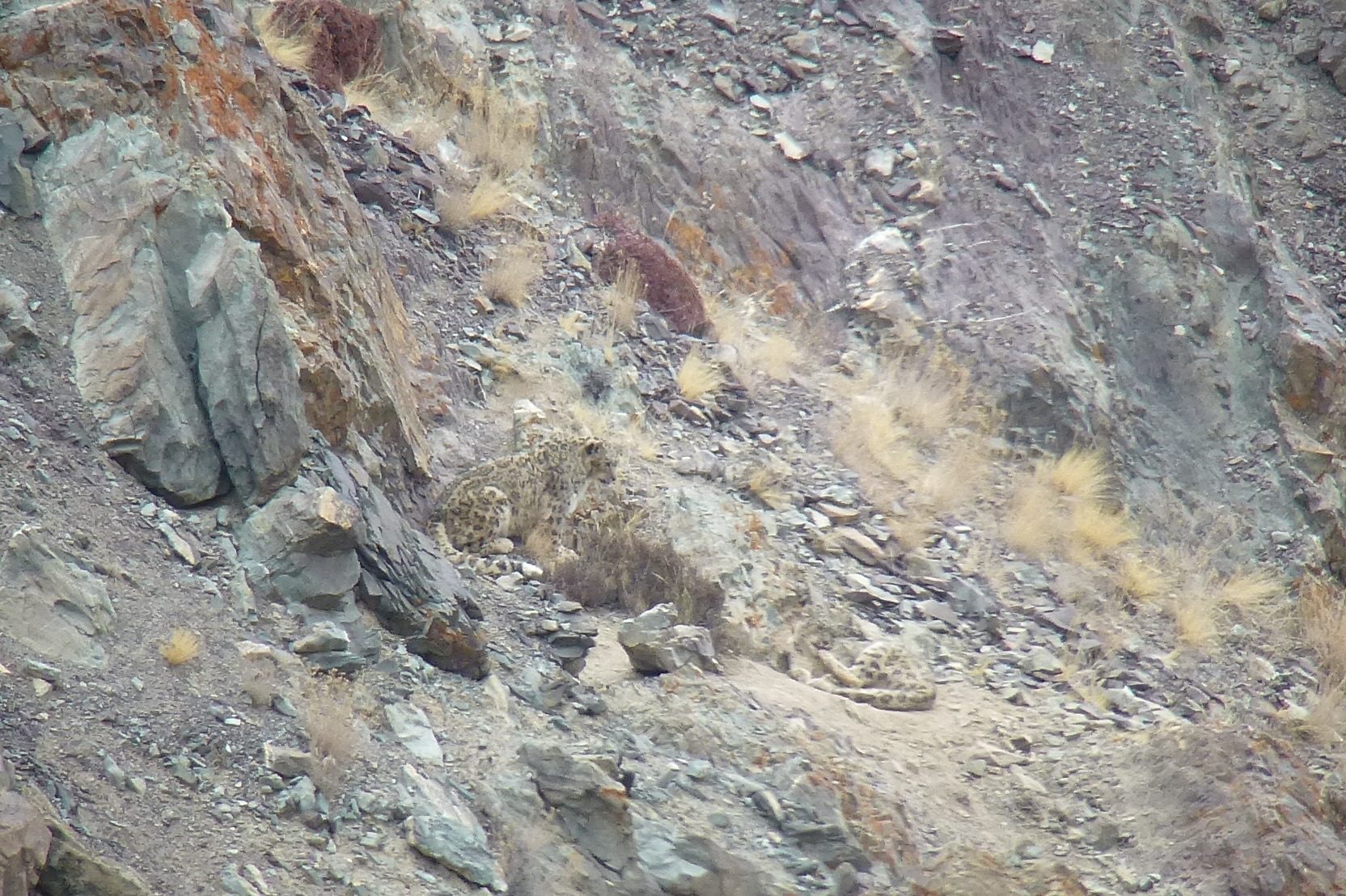
Wild image · Leh, Ladakh · India
Meet the cat
Snow leopard
Panthera uncia
A high-mountain specialist whose long tail and broad paws suit steep, cold terrain.
ConservationVulnerableVU
Relative sizeLarge
ActivityCrepuscular
LineagePanthera
Weight30–50 kg
Body length90–120 cm
Tail length80–100 cm
The mountain disappears into a cat
That extraordinary tail is a balance beam, a blanket, and almost another body length.
A snow leopard’s tail can reach a meter and measure three-quarters to nine-tenths of its head-and-body length. It counterbalances leaps and turns on steep rock, stores fat, and wraps around the face and body when the cat rests in bitter cold.
Look again at the photograph. The cat is near the center, yet rock-colored rosettes erase its outline. This is not camouflage against endless snow; it is camouflage for a high mountain made of stone, shadow, sparse grass, and seasonal ice.
Habitat and range
Twelve countries share one high-mountain cat.
Snow leopards range across the mountains of Central and South Asia, from the Himalayas and Tibetan Plateau to the Pamirs, Tien Shan, Altai, and mountains of Mongolia. They favor steep, broken terrain with cliffs, ridges, gullies, and enough wild ungulates to hunt.
An enormous mapped range does not mean continuous habitat. Valleys, roads, mines, borders, grazing pressure, and warming conditions divide mountain systems, while reliable population estimates remain difficult in remote terrain.
How it belongs
Built for this particular world.
A tail that does several jobs
Paws that spread the load
Cold air, prepared before the lungs
The conservation reality
The ghost of the mountains leaves tracks through human lives.
The snow leopard is Vulnerable and projected to decline. The latest range-wide estimate suggests roughly 2,710–3,386 mature animals, but the Cat Specialist Group stresses that reliable abundance data are still lacking.
- Retaliation after livestock losses
- Declining wild sheep and goat prey
- Competition with domestic livestock
- Poaching and illegal trade
- Mining, roads, and other infrastructure
- Climate-driven habitat change
- Weak population data across remote range
What effective work looks like
Protect the cat by making mountain coexistence possible.
People, livestock, wild prey, and snow leopards share the same high valleys. Durable conservation reduces the risk and cost carried by local households while protecting connected habitat across national borders.
Secure livestock at night
Predator-resistant corrals, herding support, and practical husbandry prevent losses before conflict begins.
Share risk and benefit
Insurance, compensation, conservation agreements, and locally owned wildlife tourism can make a living snow leopard worth more than retaliation.
Connect research across borders
Standardized camera trapping, genetics, prey monitoring, and transboundary planning turn scattered mountain data into range-wide decisions.
From hope to participation
The famous photograph is only the first step up the mountain.
Zoo-EV will connect the snow leopard’s beauty to the people doing the daily work of coexistence. Participation means helping communities, prey, field teams, and connected mountain landscapes move forward together.
Participate in the missionScientific sources, review, and image provenance
Scientific review: August 23, 2026. This account will continue to change when stronger evidence or updated specialist assessments become available.
- IUCN SSC Cat Specialist Group · Snow leopard
- Global Snow Leopard & Ecosystem Protection Program
- Image: Sheelagh Halsey · wild · Leh, Ladakh · India · CC BY 4.0