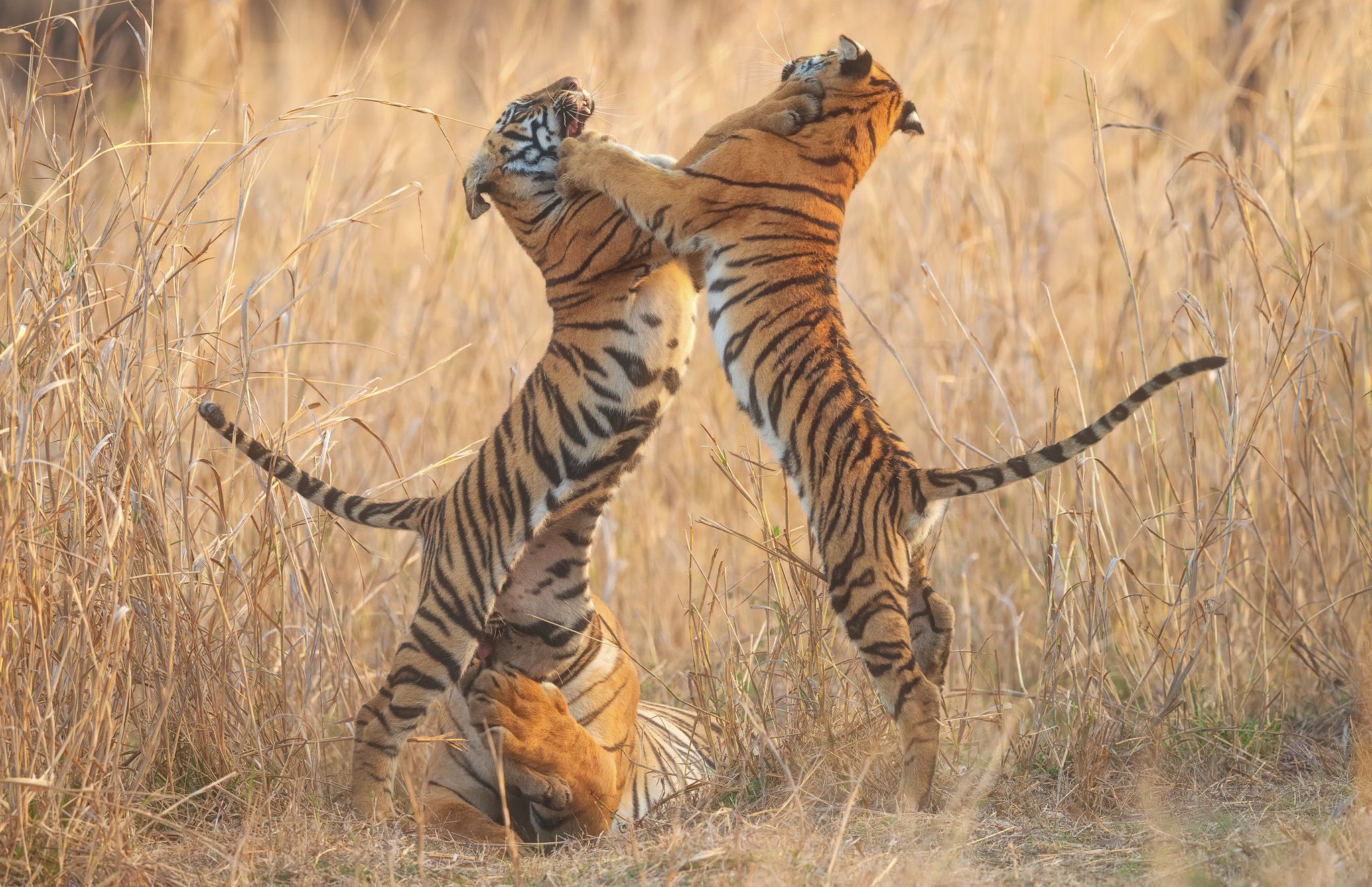
Wild image · Chandrapur, Maharashtra · India
Meet the cat
Tiger
Panthera tigris
The largest living cat, occupying habitats from tropical forest to snowy taiga.
ConservationEndangeredEN
Relative sizeLarge
ActivityFlexible
LineagePanthera
Weight75–325 kg
Body length150–230 cm
Tail length90–110 cm
Famous does not mean fully known
Everyone recognizes a tiger. Its living world is much harder to see.
The tiger is the largest living cat and the only one whose body is patterned entirely by stripes. Every individual carries a different arrangement, allowing researchers to identify tigers from photographs as reliably as a natural barcode.
Recognition can create a false sense of security. The species now occupies less than seven percent of its historic range, and even the number and boundaries of its subspecies remain under scientific review. A familiar face can still hold unanswered questions.
Habitat and range
There is no single tiger landscape.
Tigers live in tropical and temperate forest, grassland, floodplain, mangrove, and the snowy forests of the Russian Far East. What joins those places is not scenery but enough large prey, water, cover, and room for wide-ranging animals.
Today breeding populations survive in ten countries, many in isolated reserves surrounded by dense human use. Corridors between them can determine whether young tigers disperse safely or populations become genetic islands.
How it belongs
Built for this particular world.
No two stripe maps match
A body built for decisive ambush
A swimmer across landscapes
The conservation reality
An icon survives in fragments of its former world.
The tiger is Endangered. The latest specialist synthesis estimated about 3,726–5,578 independent individuals in 2021, yet only around 3,140 were likely mature. The IUCN Green Status calls the species Critically Depleted.
- Poaching and illegal trade
- Loss of deer and other wild prey
- Habitat conversion and fragmentation
- Roads, railways, dams, and development
- Conflict and retaliatory killing
- Small isolated breeding populations
- Uneven protection outside reserves
What effective work looks like
More tigers require more than guarded islands.
Protected breeding sites have produced real recoveries. The next challenge is to secure prey, movement corridors, and coexistence across the human-used landscapes between those strongholds.
Protect breeding populations and prey
Effective patrols, judicial follow-through, and prey recovery give tiger numbers a durable ecological foundation.
Keep corridors functional
Wildlife crossings, land-use planning, and connected forest let dispersing tigers move without isolating populations or intensifying conflict.
Make coexistence work locally
Rapid response, livestock protection, fair compensation, and meaningful community benefit reduce the cost of living beside a large predator.
From hope to participation
Let the world’s most famous cat open the door for the other forty.
Zoo-EV will not treat tiger attention as the whole mission. Participation can use that recognition to protect shared landscapes, strengthen field conservation, and introduce people to the smaller cats living beyond the spotlight.
Participate in the missionScientific sources, review, and image provenance
Scientific review: August 23, 2026. This account will continue to change when stronger evidence or updated specialist assessments become available.
- IUCN SSC Cat Specialist Group · Tiger
- IUCN Green Status · Tiger
- Image: Morten Ross · wild · Chandrapur, Maharashtra · India · CC BY 4.0