
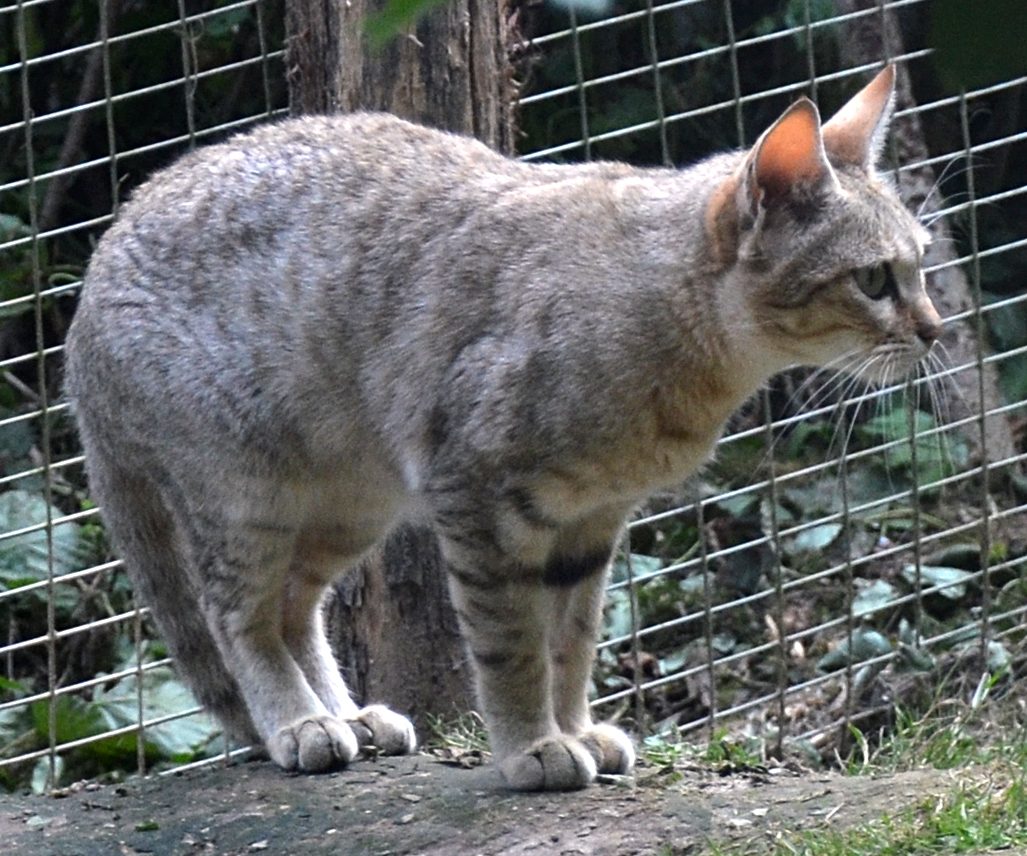
Captive image · Parc des Félins · France
Meet the cat
Afro-Asiatic wildcat
Felis lybica
The wild ancestor of the domestic cat still persists across Africa and Southwest Asia.
ConservationLeast ConcernLC
Relative sizeSmall
ActivityNocturnal
LineageDomestic cat
Weight2–8 kg
Body length40.6–80 cm
Tail length21.5–37.5 cm
The wild cat inside a familiar silhouette
Every domestic cat carries part of this wildcat’s story.
The Afro-Asiatic wildcat is the sole wild ancestor of the domestic cat. That relationship makes it look familiar—but a shared outline should not erase the wild animal: longer-legged, lightly built, and shaped by landscapes from African savanna to Central Asian steppe.
Its coat changes with place. Cats in dry country tend to be pale and faintly marked; those in wetter habitat can be darker and more patterned. Across that enormous range, three provisional subspecies connect many local forms within one species.
Habitat and range
One species follows cover and prey across two continents.
Afro-Asiatic wildcats use deserts, semi-deserts, savannas, scrub, open woodland, rocky hills, mountain vegetation, and some agricultural landscapes. They generally avoid closed rainforest, vast bare desert, and deep snow.
They need more than open space. Shrubs, tall grass, rocks, crops, and abandoned burrows provide concealment and shelter, while rodents and other small prey determine where a territory can support a cat.
How it belongs
Built for this particular world.
A coat that changes with climate
Long legs under a light frame
A generalist with limits
The conservation reality
Abundance can hide the loss of wild identity.
The Afro-Asiatic wildcat is classified as Least Concern, yet population size and trend remain poorly known. Its closest relationship—with domestic cats—also creates one of its most difficult conservation problems.
- Hybridisation with domestic cats
- Disease and competition from free-ranging cats
- Retaliatory killing and indiscriminate control
- Road mortality and free-ranging dogs
- Habitat conversion and declining quality
- Poaching and local wildlife trade
What effective work looks like
Protect the wildcat and manage the domestic-cat boundary.
Conservation needs landscape protection and better knowledge of where genetically distinct wild populations remain. It also needs practical action around people and their animals.
Map wild populations accurately
Genetics, camera traps, and consistent identification can distinguish wildcats, hybrids, and feral domestic cats across a complex range.
Reduce unmanaged domestic-cat pressure
Responsible ownership, vaccination, sterilisation, and targeted feral-cat management can reduce hybridisation and disease.
Make working landscapes safer
Conflict prevention, wildlife-friendly control methods, road mitigation, and retained cover help wildcats persist outside reserves.
From hope to participation
The wild ancestor asks us to see domestic-cat responsibility differently.
Zoo-EV will connect this story to credible wildcat research and humane, evidence-led domestic-cat management. Participation begins close to home: responsible pet ownership can be part of protecting wild relatives.
Participate in the missionScientific sources, review, and image provenance
Scientific review: August 22, 2026. This account will continue to change when stronger evidence or updated specialist assessments become available.
- IUCN SSC Cat Specialist Group · Afro-Asiatic wildcat
- 2017 revised taxonomy of Felidae
- Image: Vassil · captive · Parc des Félins · France · CC0 1.0