
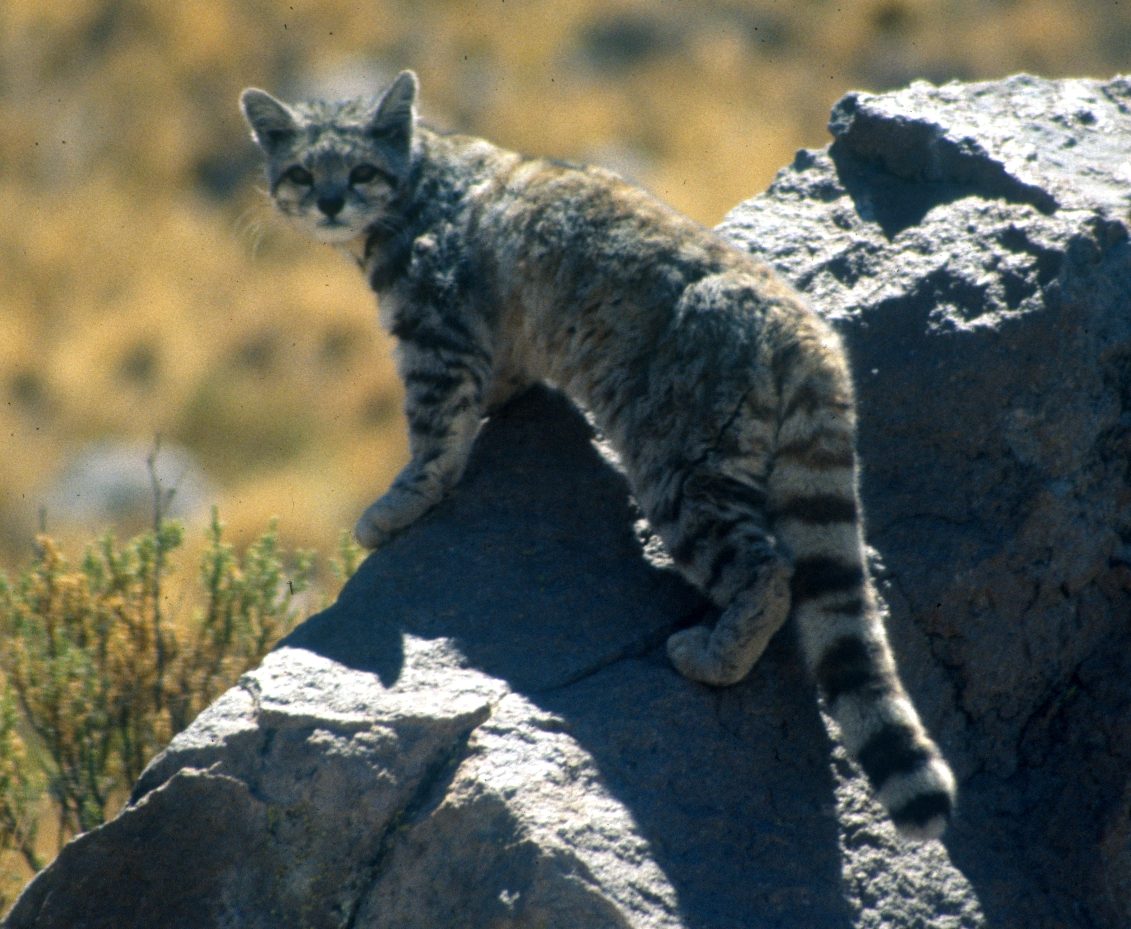
Wild image · High Andes · precise location not recorded
Meet the cat
Andean mountain cat
Leopardus jacobita
One of the least-known cats on Earth, living among rock and sparse vegetation at extreme elevation.
ConservationEndangeredEN
Relative sizeSmall
ActivityCrepuscular
LineageOcelot
Weight4–6 kg
Body length57–75 cm
Tail length41–48 cm
A quiet presence above the clouds
One of the world’s rarest cats lives where the land seems almost empty.
The Andean mountain cat moves through rock fields, steep valleys, and dry high-country grasslands where cold, wind, and thin air shape every life. Its long, thick tail—nearly as long as its body—helps identify it and may aid balance among broken rock.
For much of modern science, even seeing one was exceptional. That rarity is not only a matter of secrecy: the species occurs at very low densities across a vast, fragmented range. Every reliable sighting helps turn an outline on a map into a living conservation story.
Habitat and range
Rock, water, prey, and distance define its mountain world.
Most records come from the arid and semi-arid Andes of Argentina, Bolivia, Chile, and Peru, often above 3,000 meters. The cat also reaches lower-elevation steppe and rocky landscapes in northern Patagonia.
Rocky terrain matters because it shelters the mountain vizcacha, an important prey species. In this sparse environment, wetlands and water sources can concentrate wildlife—and can also become points of pressure when water is diverted, contaminated, or disturbed.
How it belongs
Built for this particular world.
A tail made for rock
A coat for high country
A life built around scarce prey
The conservation reality
Rarity magnifies every break in the landscape.
The Andean mountain cat is Endangered, with fewer than 2,500 mature individuals estimated across its range. No single subpopulation is thought to contain more than 250 mature cats.
- Mining, roads, and expanding infrastructure
- Water extraction and contamination
- Habitat fragmentation and prey decline
- Free-ranging dogs and disease
- Hunting and accidental killing
- Climate-driven change in high-elevation systems
What effective work looks like
Conservation crosses borders—and begins with local knowledge.
Because the cat’s range spans four countries and many communities, useful work connects field evidence, shared standards, and practical coexistence rather than treating each sighting in isolation.
Find the hidden populations
Camera traps, genetic evidence, and community observations refine distribution, population, and corridor priorities.
Protect connected mountain systems
Safeguarding rock habitat, wetlands, prey, and movement routes keeps the larger high-Andes community functioning.
Build conservation with communities
Education, locally led monitoring, dog management, and alternatives to hunting make protection durable on the ground.
From hope to participation
A rare cat becomes less invisible when knowledge is shared across a range.
Zoo-EV will look for ways to support credible, locally rooted Andean cat research and coexistence. Until a partnership is announced, participation means learning the landscape behind the animal and following the work of the Andean Cat Alliance.
Participate in the missionScientific sources, review, and image provenance
Scientific review: August 22, 2026. This account will continue to change when stronger evidence or updated specialist assessments become available.
- IUCN SSC Cat Specialist Group · Andean mountain cat
- Andean Cat Alliance · Conservation network
- Image: Jim Sanderson · wild · High Andes · precise location not recorded · CC BY-SA 3.0