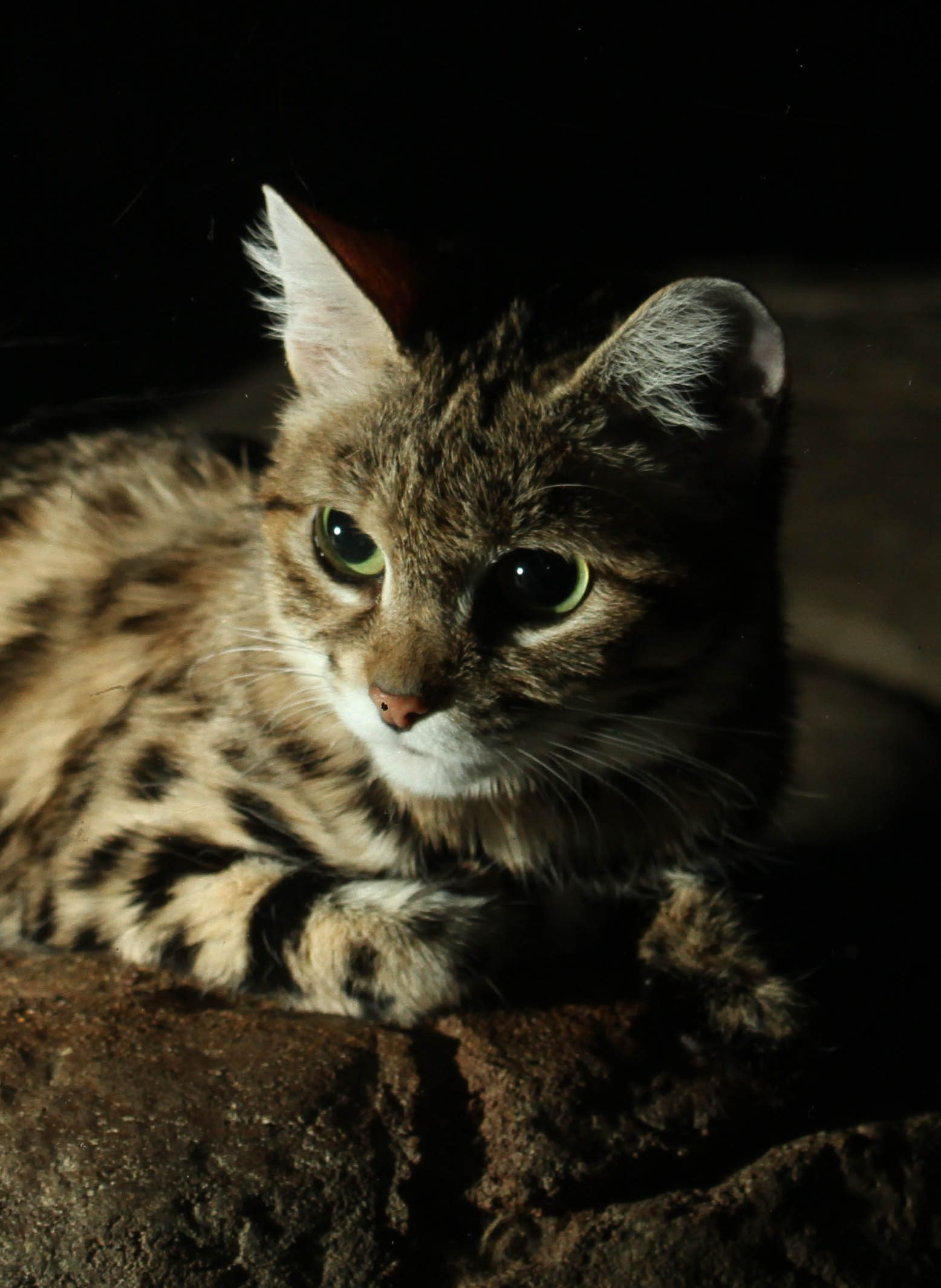
Captive image · Cincinnati Zoo
Meet the cat
Black-footed cat
Felis nigripes
Africa’s smallest cat is an exceptionally active hunter of dry grasslands and semi-desert.
ConservationVulnerableVU
Relative sizeSmall
ActivityNocturnal
LineageDomestic cat
Weight1–2.5 kg
Body length35–52 cm
Tail length15–20 cm
Small body. Remarkable nightly effort.
Africa’s smallest cat survives by staying relentlessly in motion.
The black-footed cat can weigh less than a house cat, yet it may pursue one small meal after another through an entire night. Researchers have recorded individuals taking roughly 10 to 14 small vertebrates in a night—a hunting rhythm matched to tiny prey and a fast metabolism.
Its name comes from the dark soles of its feet, not entirely black legs. Those feet cross dry grassland and semi-desert where shade and surface water may be scarce, and where an abandoned springhare burrow or termite mound can become essential shelter.
Habitat and range
Open country is not empty country.
Black-footed cats inhabit arid grassland, savanna, and semi-desert in southern Africa, including the Karoo and Kalahari. They generally avoid the driest true desert and landscapes without enough cover or prey.
They shelter by day in burrows, rock crevices, and hollow termite mounds, then emerge after dark to hunt rodents, small birds, reptiles, and invertebrates. Moisture from prey allows them to remain largely independent of open water.
How it belongs
Built for this particular world.
Hunting in small increments
Shelter borrowed from others
Water carried in prey
The conservation reality
The threats are often quiet, scattered, and cumulative.
The black-footed cat is Vulnerable. Because it occurs at low density and depends on healthy small-prey communities, changes that seem minor can accumulate across a working landscape.
- Habitat degradation and conversion
- Overgrazing and reduced prey or den sites
- Indiscriminate poison and traps
- Road mortality and free-ranging dogs
- Disease shared with domestic animals
- Increasing aridity and climate change
What effective work looks like
Long-term field work makes an unseen cat legible.
The species benefits from conservation that joins individual health, prey, habitat, and land-use decisions. Decades of multidisciplinary research now provide a stronger base for action.
Follow individuals over time
Radio tracking, health checks, genetics, and reproduction data reveal survival patterns that brief surveys cannot.
Reduce preventable mortality
Safer predator-control practices, dog management, and road awareness can remove hazards without separating conservation from ranching.
Keep drylands biologically rich
Healthy grazing systems and intact burrow-forming wildlife protect the prey and shelter on which this cat depends.
From hope to participation
Small-cat conservation often succeeds through details people can change.
Zoo-EV will prioritize evidence-led work that reduces accidental mortality and supports long-term field knowledge. The first step is to replace the myth of an empty dryland with a more accurate picture of a living system.
Participate in the missionScientific sources, review, and image provenance
Scientific review: August 22, 2026. This account will continue to change when stronger evidence or updated specialist assessments become available.
- IUCN SSC Cat Specialist Group · Black-footed cat
- Black-footed Cat Working Group
- Image: Mark Dumont · captive · Cincinnati Zoo · CC BY 2.0