
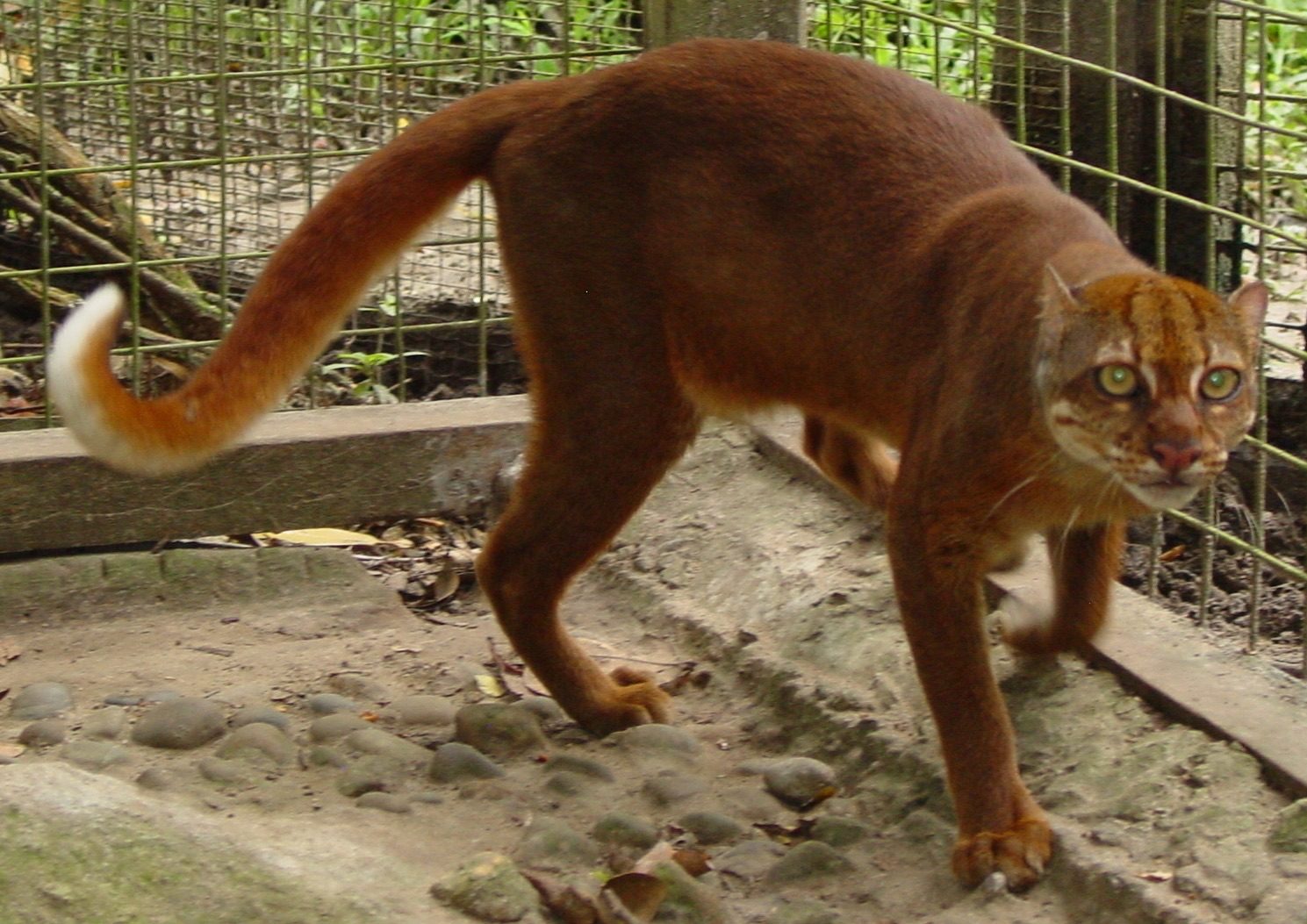
Captive image · Sarawak, Malaysia · 2005
Meet the cat
Bornean bay cat
Catopuma badia
An island endemic known from remarkably few encounters and camera-trap records.
ConservationEndangeredEN
Relative sizeSmall
ActivityNocturnal
LineageBay cat
Weight3–4 kg
Body length53–67 cm
Tail length32–40 cm
Borneo’s cat of few encounters
Some species are rare in the forest—and rare in our knowledge.
The Bornean bay cat is found nowhere but Borneo. It has been documented so infrequently that basic questions about its diet, reproduction, movements, and social life remain unanswered. Even large camera-trap studies often record it only a handful of times—or not at all.
Its coat can appear deep chestnut or grey, and its unusually long tail reinforces a silhouette unlike Borneo’s other small cats. But the most important fact is not how little we see. It is how much forest must remain connected while science catches up.
Habitat and range
The island’s forests are the whole known world of this cat.
Records come from primary and selectively logged forest, lowlands and uplands, swamp forest, and forest near rivers. Evidence strongly suggests a forest-dependent species, even though the precise habitat features it needs are still being resolved.
Camera traps have recorded bay cats from sea level to high elevations. Their scarcity makes absence difficult to interpret: a place with no photograph may lack cats, or it may simply reflect how hard this species is to detect.
How it belongs
Built for this particular world.
A tail nearly two-thirds of the body
More than one color
Mystery is not an adaptation
The conservation reality
A narrow range leaves little room for sustained forest loss.
The Bornean bay cat is Endangered. A specialist estimate suggests roughly 2,200 mature individuals, but the figure depends on major assumptions because robust population data do not yet exist.
- Deforestation and forest fragmentation
- Commercial logging and plantation expansion
- Hydroelectric and other infrastructure development
- Snares and illegal wildlife trade
- A range restricted to one island
- Major gaps in population and ecological knowledge
What effective work looks like
Protect the forest while building the evidence.
For a species this little known, waiting for perfect data would be its own decision. Conservation can safeguard likely habitat now while improving how the cat is detected and studied.
Keep large forests connected
Protected areas, responsible forest management, and corridors preserve options for a species whose exact spatial needs remain uncertain.
Design surveys for rarity
Coordinated camera-trap and genetic work can distinguish true absence from low detectability and reveal population structure.
Remove indiscriminate hazards
Anti-snaring work and trade enforcement protect the bay cat alongside many better-known forest species.
From hope to participation
Uncertainty is a reason to pay attention, not a reason to look away.
Zoo-EV will present what is known without inventing what is not. Participation can help keep rare-cat surveys, forest protection, and anti-snaring work visible while researchers continue to uncover the bay cat’s story.
Participate in the missionScientific sources, review, and image provenance
Scientific review: August 22, 2026. This account will continue to change when stronger evidence or updated specialist assessments become available.
- IUCN SSC Cat Specialist Group · Bornean bay cat
- Borneo Carnivore Symposium · species conservation planning
- Image: Jim Sanderson · crop by Abujoy · captive · Sarawak, Malaysia · 2005 · CC BY-SA 3.0