
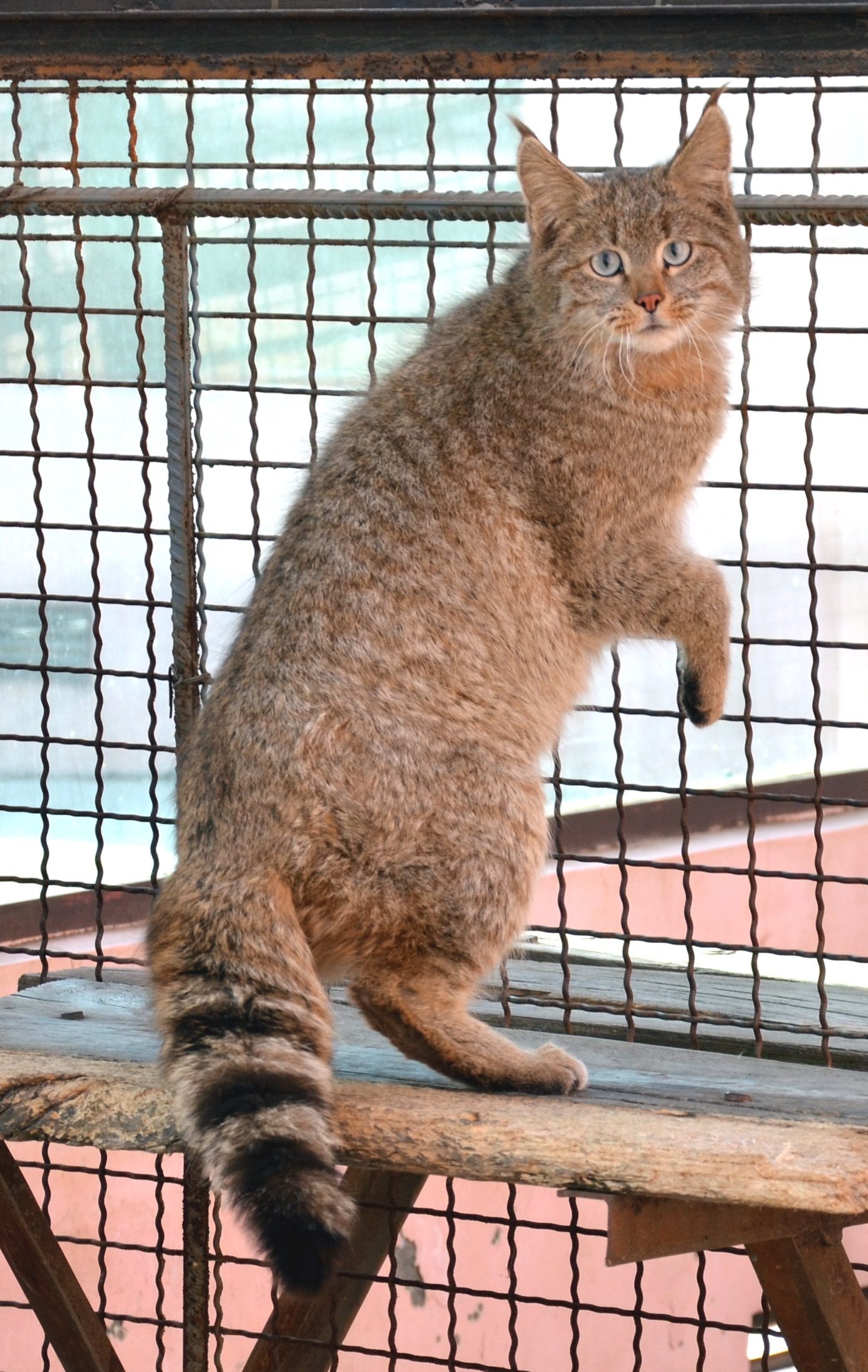
Captive image · Xining Wildlife Park · China
Meet the cat
Chinese mountain cat
Felis bieti
A little-known endemic of the high grasslands and shrublands of the Tibetan Plateau.
ConservationVulnerableVU
Relative sizeSmall
ActivityNocturnal
LineageDomestic cat
Weight5.5–9 kg
Body length60–85 cm
Tail length29–35 cm
China’s grass cat
A mountain cat listens for prey moving beneath the earth.
On the eastern Qinghai-Tibet Plateau, local people call it the grass cat. Its muted seasonal coat echoes dry alpine vegetation, while a stocky body, short legs, tufted ears, and a thick ringed tail set it apart from the lighter Afro-Asiatic wildcat.
The Chinese mountain cat hunts mole rats by listening for movement just below the soil and digging them from their tunnels. That intimate link between predator, prey, grassland, and grazing practice is central to its conservation.
Habitat and range
This cat belongs to high grasslands—not to true desert.
The species is endemic to China and restricted to the eastern Qinghai-Tibet Plateau, principally in Qinghai, Gansu, Sichuan, and Tibet. Most records fall between 2,500 and 5,000 meters.
It uses alpine steppe, meadow, shrubland, loess hills, and some forest edges under harsh seasonal extremes. Despite the older name “Chinese desert cat,” it has never been recorded in desert habitat.
How it belongs
Built for this particular world.
Hearing below the surface
Grass-colored camouflage
Borrowed mountain shelter
The conservation reality
When prey control removes prey, the predator inherits the poison.
The Chinese mountain cat is Vulnerable, with fewer than 10,000 mature individuals estimated and a declining, likely fragmented population.
- Large-scale poisoning of pikas and other small mammals
- Secondary poisoning and depleted prey
- Overgrazing and grassland degradation
- Infrastructure and habitat fragmentation
- Road mortality
- Illegal trade in skins
- Potential genetic mixing with domestic cats
What effective work looks like
Healthy grasslands need predators as well as prey.
Effective conservation treats small mammals as part of the plateau ecosystem rather than automatically as pests, while filling large gaps in the cat’s distribution and ecology.
Replace broad poisoning campaigns
Grazing management and ecosystem-based responses can address outbreaks without removing prey or exposing predators to toxic chemicals.
Survey the plateau systematically
Camera traps, genetics, and coordinated records can identify populations, corridors, and priority landscapes.
Strengthen protection on the ground
Enforcement against skin trade, road mitigation, and evaluation of protected areas can turn national protection into measurable survival.
From hope to participation
The grass cat reveals why every part of a food web matters.
Zoo-EV will look for work that joins small-cat research with high-plateau stewardship. Participation begins by sharing the accurate story: this is a grassland endemic, not a desert cat and not simply another form of domestic cat.
Participate in the missionScientific sources, review, and image provenance
Scientific review: August 22, 2026. This account will continue to change when stronger evidence or updated specialist assessments become available.
- IUCN SSC Cat Specialist Group · Chinese mountain cat
- Mammal Diversity Database · Felis bieti
- Image: Xining Wildlife Park · captive · Xining Wildlife Park · China · CC BY-SA 3.0