
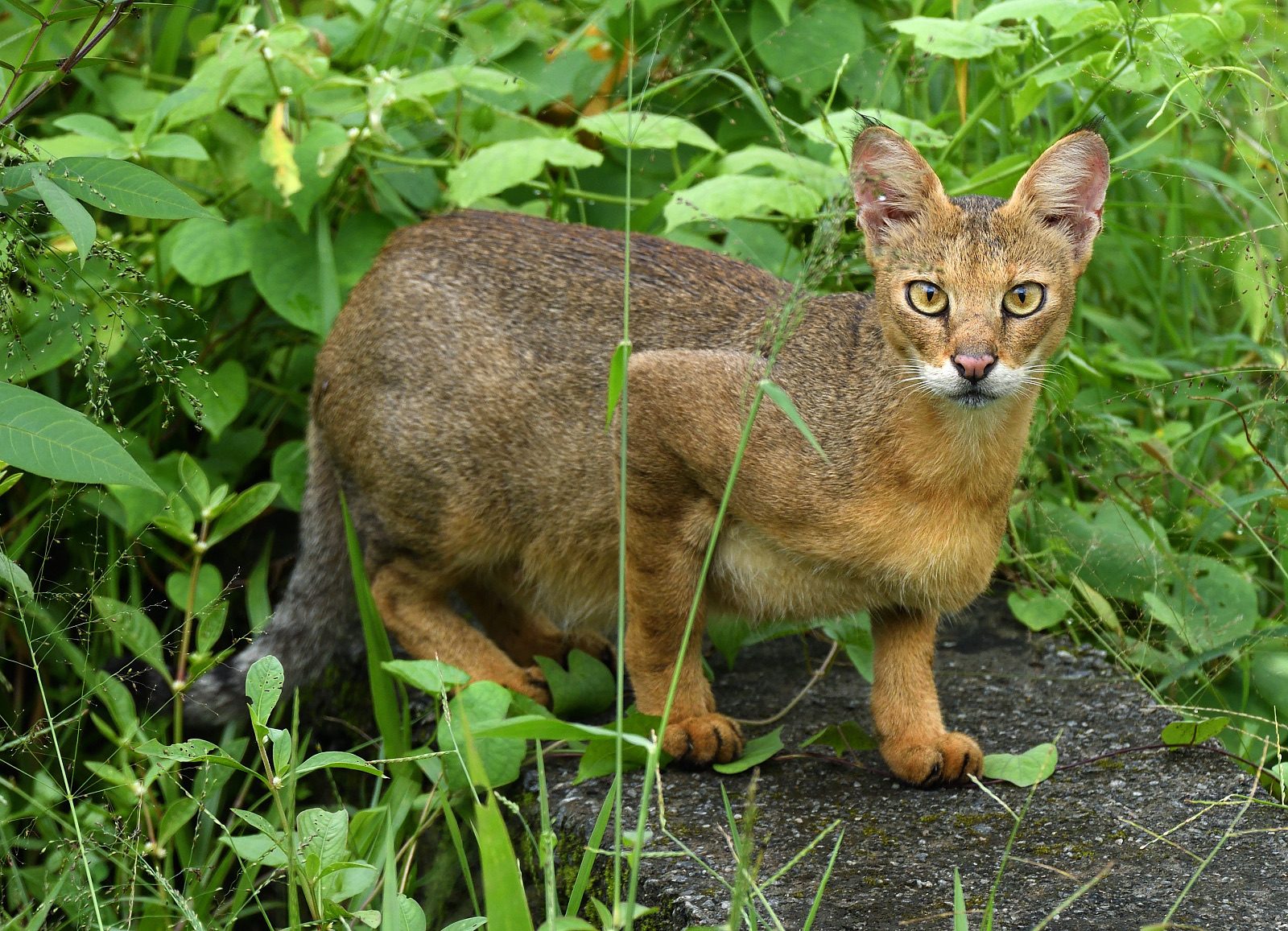
Wild image · Chengamanad, Kerala · India
Meet the cat
Jungle cat
Felis chaus
Despite its name, this long-legged cat is strongly associated with reeds, wetlands and dense cover.
ConservationLeast ConcernLC
Relative sizeMedium
ActivityFlexible
LineageDomestic cat
Weight5–9 kg
Body length58–76 cm
Tail length21–27 cm
The name sends you to the wrong habitat
Call it a jungle cat. Look for it in the reeds.
The jungle cat is not a specialist of dense jungle. Its better nickname is ‘swamp cat’: a long-legged hunter of reed beds, marshes, river edges, irrigated fields, and other places where water creates thick ground cover.
Small ear tufts and a short tail once invited comparisons with lynx, but this cat belongs close to the domestic-cat lineage. It swims, dives, jumps for birds, uses abandoned burrows, and may even raise kittens in an old building beside farmland.
Habitat and range
From Nile reeds to Himalayan fields, water draws the map.
Jungle cats range from Egypt through the Caucasus, Middle East, Central Asia, South Asia, and parts of Southeast Asia. Reed swamp and riparian vegetation are especially important, even where the surrounding landscape is desert, steppe, woodland, or dry grassland.
They also use sugarcane, irrigated agriculture, plantations, fishpond edges, and settlement margins when dense cover remains. Most records fall below 1,000 meters, though the species reaches roughly 4,000 meters in the Himalayas.
How it belongs
Built for this particular world.
Long legs above wet ground
A cat willing to dive
Natural pest control on four paws
The conservation reality
Adaptable cats still need somewhere wild to hide.
The jungle cat is globally Least Concern, yet it has declined sharply in Europe and is rare through much of Southeast Asia. Wetland clearance and indiscriminate trapping remove the cover that makes coexistence possible.
- Wetland and reed-bed destruction
- Clearing vegetation along waterways
- Snaring, trapping, and poisoned carcasses
- Retaliation after poultry loss
- Road mortality
- Attacks by free-ranging dogs
What effective work looks like
Keep the reeds—and make the farm edge safer.
Jungle cats often live beyond reserves. Protecting waterways, reducing indiscriminate killing, and securing poultry can preserve both the cat and its value as a rodent hunter.
Protect natural wetland edges
Reed beds, riparian thickets, and uncultivated strips provide den sites, concealment, and connected movement through developed land.
Secure poultry without poison
Strong enclosures and prompt husbandry reduce losses without exposing wild cats, scavengers, and other wildlife to toxic carcasses.
Map overlooked populations
Verified sightings, camera traps, and local reporting can clarify distribution where records are now scarce or outdated.
From hope to participation
Correcting the name is fun. Protecting the real habitat is the point.
Zoo-EV will use the jungle cat’s mistaken identity to reveal why reeds, drainage ditches, field margins, and responsible poultry care matter. Participation starts by noticing the wild value of ordinary-looking edges.
Participate in the missionScientific sources, review, and image provenance
Scientific review: August 23, 2026. This account will continue to change when stronger evidence or updated specialist assessments become available.
- IUCN SSC Cat Specialist Group · Jungle cat
- Cat Conservation Compendium · Jungle cat
- Image: sunnyjosef · wild · Chengamanad, Kerala · India · CC BY 4.0