
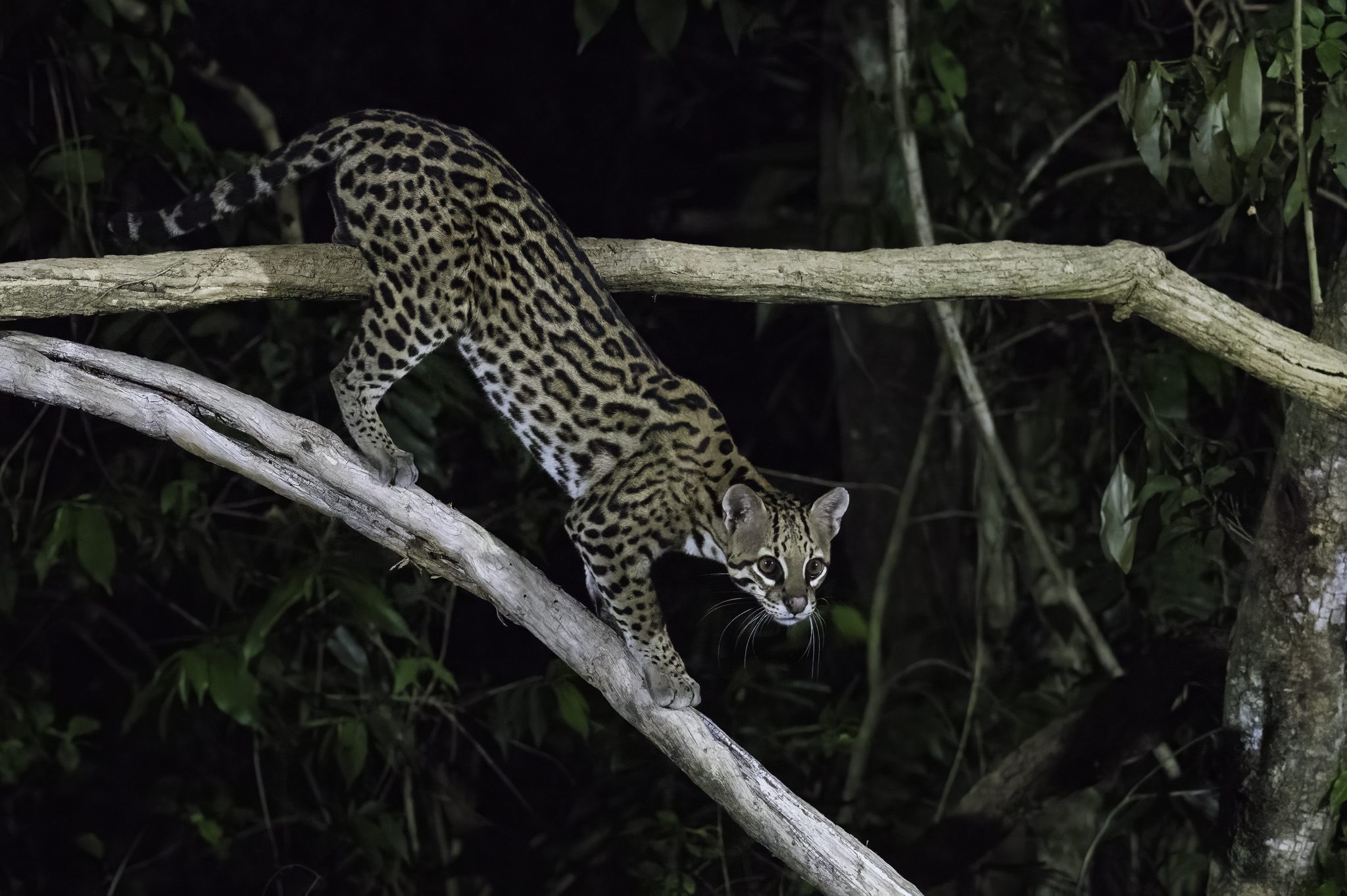
Wild image · Poconé, Mato Grosso · Brazil
Meet the cat
Ocelot
Leopardus pardalis
A patterned forest hunter whose wide range conceals intense local pressures.
ConservationLeast ConcernLC
Relative sizeMedium
ActivityNocturnal
LineageOcelot
Weight8–15.1 kg
Body length50–101.1 cm
Tail length30–50 cm
Every coat is an original
The pattern is camouflage, identity—and influence over an entire cat community.
No two ocelots carry exactly the same arrangement of spots, stripes, and chain-like rosettes. The pattern breaks up the body in forest shadow, while sturdy legs and oversized front paws carry a versatile hunter across ground, water, and branches.
Its influence extends beyond its own prey. Where ocelots are abundant, smaller cats often occur at lower densities or shift where and when they move—a debated pattern known as the ‘ocelot effect.’ The medium cat can shape the lives of the forgotten cats around it.
Habitat and range
Dense cover connects Texas brush to Amazon forest.
Ocelots range from southern Texas through Mexico, Central America, and much of South America. They use rainforest, dry forest, thorn scrub, mangrove, flooded savanna, wetlands, and plantation mosaics, but consistently depend on cover and prey.
The species may cross open or altered ground when dense habitat remains nearby, especially under darkness or cloud. Fragmentation therefore matters twice: it removes living space and turns the gaps between surviving patches into dangerous barriers.
How it belongs
Built for this particular world.
A pattern with no duplicate
Built to hunt beyond one layer
A menu larger than expected
The conservation reality
Least Concern can still mean only dozens left in a country.
Ocelots remain widespread and globally Least Concern, but the U.S. population is estimated at only about 50–80 animals in isolated Texas groups. Across the range, roads and fragmentation continue separating populations.
- Forest and wetland fragmentation
- Vehicle strikes
- Population isolation and lost genetic diversity
- Illegal pet and souvenir trade
- Poultry-related retaliation
- Free-ranging dogs and disease
What effective work looks like
Reconnect the pattern across the landscape.
Protection from commercial fur trade allowed recovery in many places. The next challenge is physical connection: habitat corridors, safe road crossings, and intact cover across farms and development.
Restore dense corridors
Native brush, forest fragments, wetlands, and buffer zones can reconnect breeding populations across agricultural and urban landscapes.
Build roads an ocelot can survive
Wildlife crossings, fencing, slower traffic, and hotspot monitoring reduce mortality and reconnect movement routes.
Reward coexistence on private land
Camera-based incentives and conservation partnerships can make living ocelots an asset to the people who share their range.
From hope to participation
Follow one set of rosettes and the whole landscape comes into view.
Zoo-EV will connect individual recognition to corridor work, road safety, and the smaller cats affected by the ocelot’s presence. Participation helps turn a beautiful pattern into a connected future.
Participate in the missionScientific sources, review, and image provenance
Scientific review: August 23, 2026. This account will continue to change when stronger evidence or updated specialist assessments become available.
- IUCN SSC Cat Specialist Group · Ocelot
- Cat Conservation Compendium · Ocelot
- Image: Emily Turteltaub Nelson · wild · Poconé, Mato Grosso · Brazil · CC BY 4.0