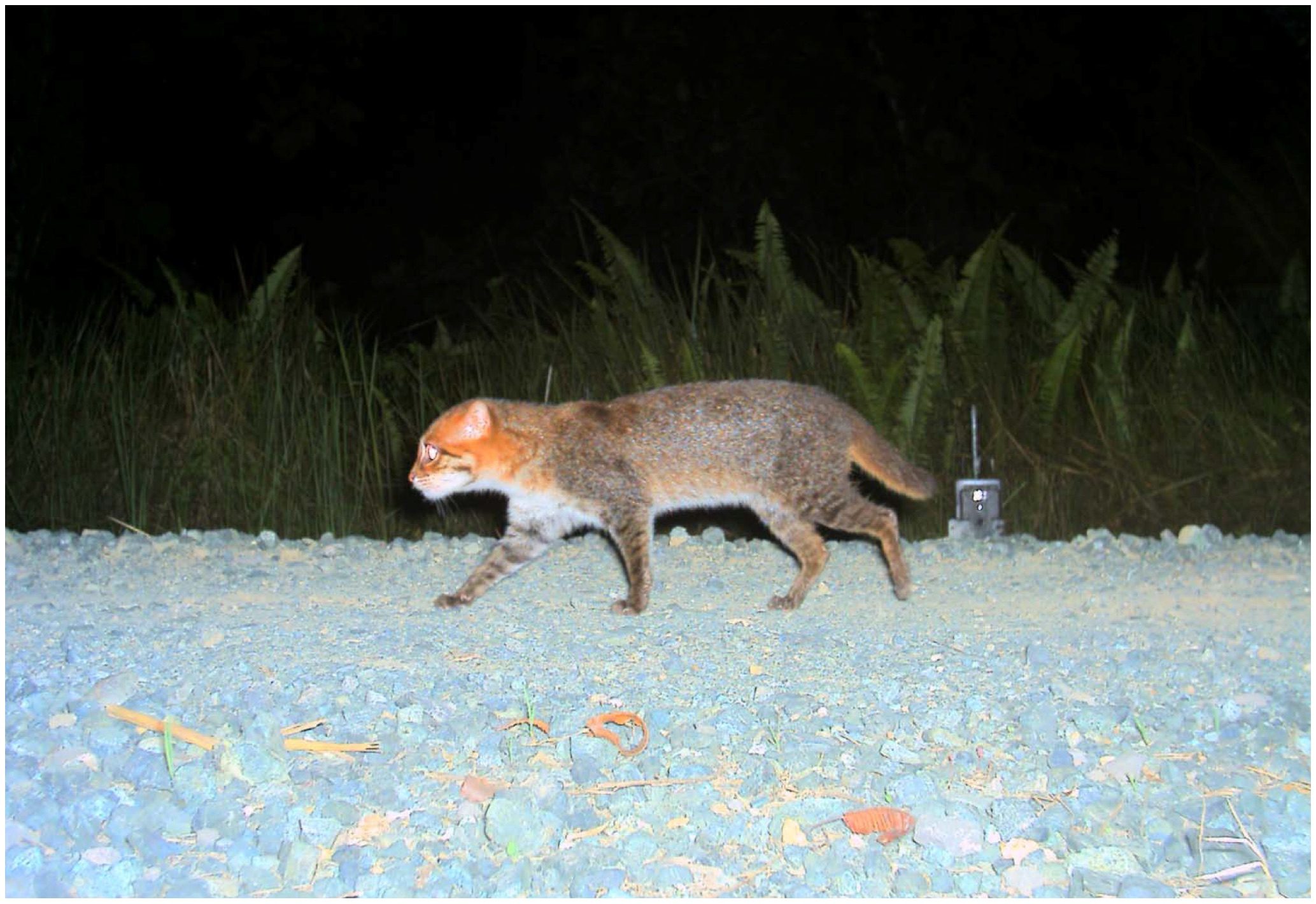
Wild image · Tangkulap Forest Reserve · Sabah, Malaysia
Meet the cat
Flat-headed cat
Prionailurus planiceps
A wetland specialist with partly webbed feet and teeth adapted for gripping aquatic prey.
ConservationEndangeredEN
Relative sizeSmall
ActivityNocturnal
LineageLeopard cat
WeightAbout 2 kg
Body length45–52 cm
Tail length13–17 cm
A cat shaped by water
The flat-headed cat belongs to the narrow edge between forest and freshwater.
With a low forehead, forward-set eyes, narrow feet, and unusually developed webbing between the toes, the flat-headed cat looks different because it lives differently. Its anatomy points toward slippery aquatic prey and hunting at the water’s edge.
It is smaller than the fishing cat and more tightly associated with lowland wetlands. Fish are important, but frogs, crustaceans, rodents, and other prey may also form part of a diet that remains incompletely known in the wild.
Habitat and range
Follow the rivers, swamps, and peatlands—and then ask whether the water still works.
The flat-headed cat survives on Sumatra, Borneo, and the Malay Peninsula, with most records close to freshwater. It uses riverine forest, peat swamp, freshwater swamp, marshes, and other wet lowlands, generally below 100 meters elevation.
Its distribution is naturally patchy because suitable wetlands are patchy. Drainage, dams, plantations, and pollution do more than remove cover: they alter the water and prey system that makes the habitat usable at all.
How it belongs
Built for this particular world.
Feet made for wet ground
Teeth for slippery prey
A sensory focus forward
The conservation reality
When a wetland is simplified, a specialist loses more than space.
The flat-headed cat is Endangered. Much of its historical lowland habitat has been transformed, and remaining populations are fragmented across some of Southeast Asia’s most intensively altered landscapes.
- Conversion to oil-palm and other agriculture
- Wetland drainage, dams, and altered water flow
- Water pollution and declining fish stocks
- Snaring, poisoning, and accidental capture
- Illegal trade and direct killing
- Severe gaps in distribution and population data
What effective work looks like
Conserve the water system, not only the strip of trees beside it.
The species needs wetland conservation that treats forest cover, water quality, prey, and human use as one connected system.
Survey the overlooked waterways
Targeted camera trapping and environmental DNA can clarify where the species persists and which wetland connections matter most.
Keep water clean and connected
Protecting peatlands, river margins, natural flow, and aquatic prey addresses the ecological system behind the cat.
Build safeguards into working landscapes
Better plantation management, reduced chemical runoff, and removal of snares can improve survival beyond protected-area boundaries.
From hope to participation
A small wetland cat can change how we value an entire waterway.
Zoo-EV will look for field partners who connect species evidence with peatland, river, and community stewardship. Until then, participation begins with recognizing that clean, functioning wetlands protect far more than the animal in the photograph.
Participate in the missionScientific sources, review, and image provenance
Scientific review: August 22, 2026. This account will continue to change when stronger evidence or updated specialist assessments become available.
- IUCN SSC Cat Specialist Group · Flat-headed cat
- Wilting et al. · Distribution model and conservation priorities
- Image: Andreas Wilting et al. · wild · Tangkulap Forest Reserve · Sabah, Malaysia · CC BY-SA 2.5