
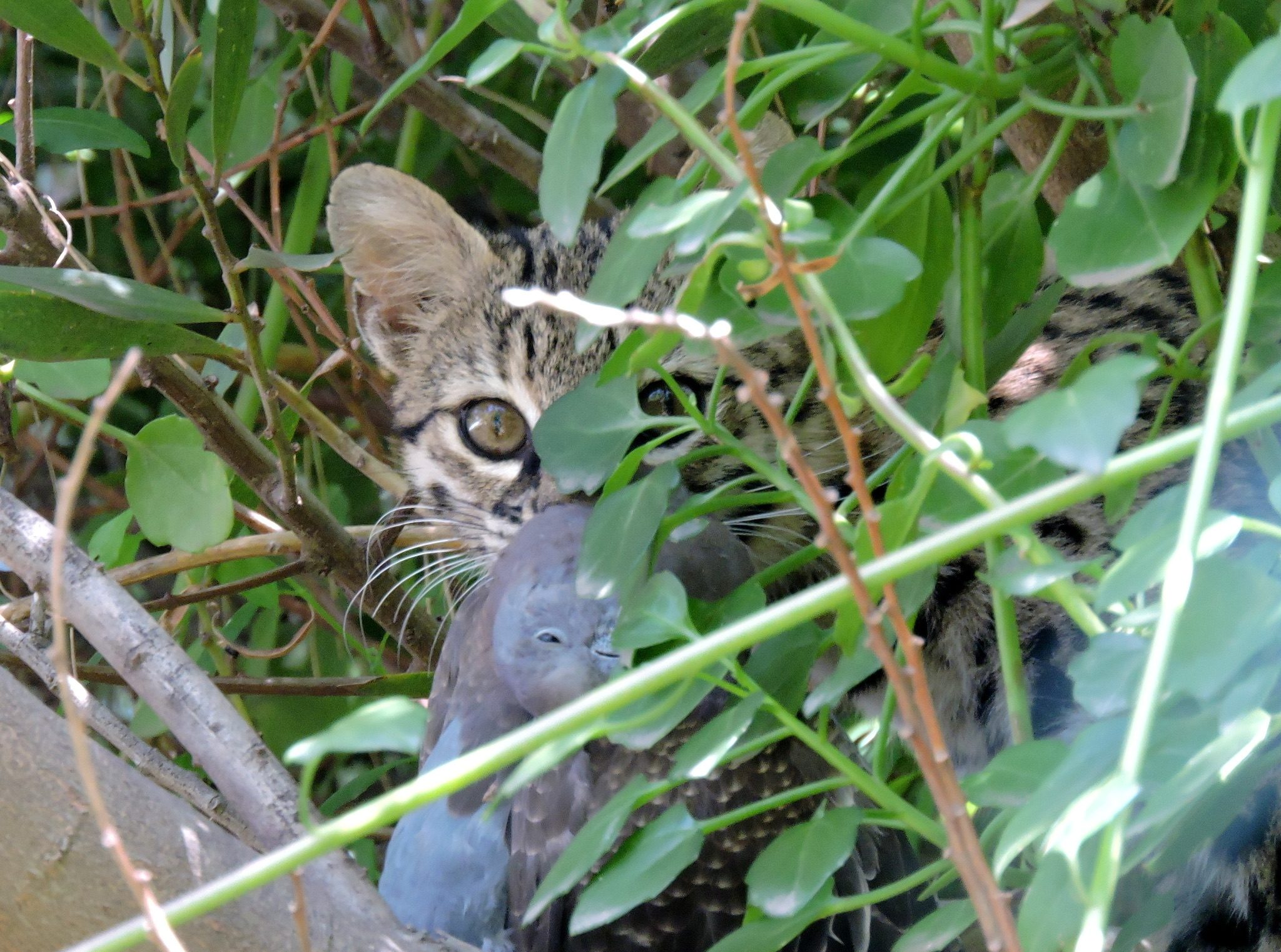
Wild image · Buenos Aires Province · Argentina
Meet the cat
Geoffroy’s cat
Leopardus geoffroyi
An adaptable hunter of southern South America’s grasslands, scrub and wetlands.
ConservationLeast ConcernLC
Relative sizeSmall
ActivityNocturnal
LineageOcelot
Weight3–6 kg
Body length43–88 cm
Tail length23–40 cm
A spotted cat that refuses one simple habitat
Geoffroy’s cat follows cover—from dry steppe to the water’s edge.
About the size of a large house cat, Geoffroy’s cat wears small, regular spots rather than rosettes. Coat color shifts from grey to tawny across its range, and all-black cats appear most often in wetter or forested landscapes.
This is primarily a ground hunter, but not a one-dimensional one. It climbs, swims, rests inside hollow trees, and adjusts its daily schedule as prey and conditions change. In some landscapes, patches of woody cover become refuges, hunting grounds, and shared scent-marking sites.
Habitat and range
A South American mosaic of grass, scrub, woodland, and water.
Geoffroy’s cats occur from southern Bolivia and Brazil through Paraguay, Uruguay, Argentina, and southern Chile. They use pampas and marsh grasslands, Chaco savanna, Patagonian scrub, Monte desert, dry woodland, riparian forest, wetlands, and coastal country—but generally not rainforest.
They can persist in altered landscapes when dense vegetation remains. That flexibility has limits: survival is higher in natural habitat, and drought, cleared cover, roads, and human-caused mortality can quickly change a locally secure population.
How it belongs
Built for this particular world.
Spots, shadows, and sometimes black
A menu that reaches the water
A clock that follows opportunity
The conservation reality
Least Concern can still contain a steep local decline.
The species is widespread and globally classified as Least Concern, but its population trend is uncertain. In the Brazilian Pampa, one repeated estimate indicated a 79% decline across three generations.
- Habitat loss and fragmentation
- Retaliatory killing around poultry
- Road mortality
- Attacks by domestic dogs
- Disease exposure from domestic carnivores
- Local hunting and illegal trade
What effective work looks like
Keep cover connected and make human-dominated landscapes safer.
A broad range should not invite a one-size-fits-all plan. Conservation must distinguish locally stable populations from places where mortality and habitat change are accumulating.
Repeat local population studies
Comparable surveys over time can reveal declines that disappear inside a reassuring global range map.
Retain native cover and corridors
Wood patches, riparian strips, shrublands, and wetland edges give cats places to hunt, rest, communicate, and move.
Reduce preventable mortality
Poultry protection, dog management, road planning, and community response can address several immediate threats together.
From hope to participation
A familiar conservation category should never end our curiosity.
Zoo-EV will use Geoffroy’s cat to show why local evidence matters: a species can be widespread while particular populations are quietly losing ground. Participation helps keep those overlooked changes visible.
Participate in the missionScientific sources, review, and image provenance
Scientific review: August 23, 2026. This account will continue to change when stronger evidence or updated specialist assessments become available.
- IUCN SSC Cat Specialist Group · Geoffroy’s cat
- CatSG species assessment · Geoffroy’s cat
- Image: Diego Hernan Perez · wild · Buenos Aires Province · Argentina · CC BY 4.0