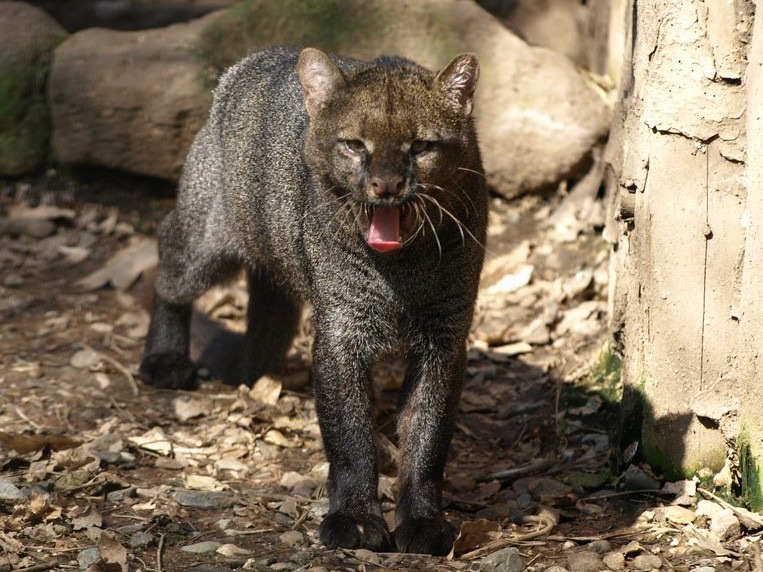
Captive image · Zoo Děčín · Czech Republic
Meet the cat
Jaguarundi
Herpailurus yagouaroundi
Long-bodied, short-legged and often active by day, it looks unlike any other cat in the Americas.
ConservationLeast ConcernLC
Relative sizeSmall
ActivityDiurnal
LineagePuma
Weight2.5–7.6 kg
Body length48.8–77.5 cm
Tail length27.5–59 cm
The cat that rewrites the silhouette
Long, low, daytime-active—and capable of at least thirteen calls.
With a narrow head, rounded ears, short legs, a long body, and an even longer tail, the jaguarundi looks so unlike the usual idea of a cat that ‘otter cat’ has become one of its nicknames. Its closest living relatives include the puma and cheetah.
It is also unusually vocal. Researchers describe a repertoire of at least thirteen calls, including whistles, chirps, chatter, purrs, and birdlike sounds. Most hunting happens during the day, helping it use the same landscape on a different schedule from many neighboring cats.
Habitat and range
A flexible cat that still needs somewhere dense to disappear.
Jaguarundis range from Mexico through Central America and much of South America to central Argentina. They use scrub, savanna, grassland, wetland margins, dry forest, rainforest edges, cloud forest, and altered mosaics.
The long habitat list can be misleading. Dense ground vegetation appears to be a recurring requirement, and riparian forest can become an essential movement route through farms and fragmented land. Open pasture and industrial agriculture may offer edges without offering security.
How it belongs
Built for this particular world.
A body made for ground cover
Daylight changes the neighborhood
One species, several colors
The conservation reality
A wide range can hide a cat that is uncommon almost everywhere.
The jaguarundi is globally classified as Least Concern, but population density is poorly known and often estimated at only one to five animals per 100 square kilometers—or less.
- Habitat loss and fragmentation
- Loss of dense ground cover and corridors
- Road mortality
- Prey decline
- Retaliatory killing around poultry
- Capture, by-catch, and local exploitation
What effective work looks like
Protect connected cover—and learn how many cats remain.
The jaguarundi’s ability to use altered landscapes is not a substitute for evidence. Better monitoring and connected vegetation can turn apparent adaptability into real persistence.
Design surveys for an unmarked cat
Because individuals lack reliable coat patterns, monitoring needs methods that do not assume every camera-trap image can identify an animal.
Keep riparian corridors intact
Dense vegetation beside waterways can connect habitat across agricultural and developed landscapes.
Reduce roads and conflict as barriers
Crossing mitigation, safer land planning, and practical poultry protection can reduce avoidable deaths.
From hope to participation
The strange-looking cat is an invitation to look twice.
Zoo-EV will make the jaguarundi memorable without pretending it is secure. Participation means turning curiosity into support for the field surveys and connected landscapes this thinly distributed cat needs.
Participate in the missionScientific sources, review, and image provenance
Scientific review: August 23, 2026. This account will continue to change when stronger evidence or updated specialist assessments become available.
- IUCN SSC Cat Specialist Group · Jaguarundi
- 2017 revised taxonomy of Felidae
- Image: Alena Houšková · captive · Zoo Děčín · Czech Republic · CC BY-SA 3.0