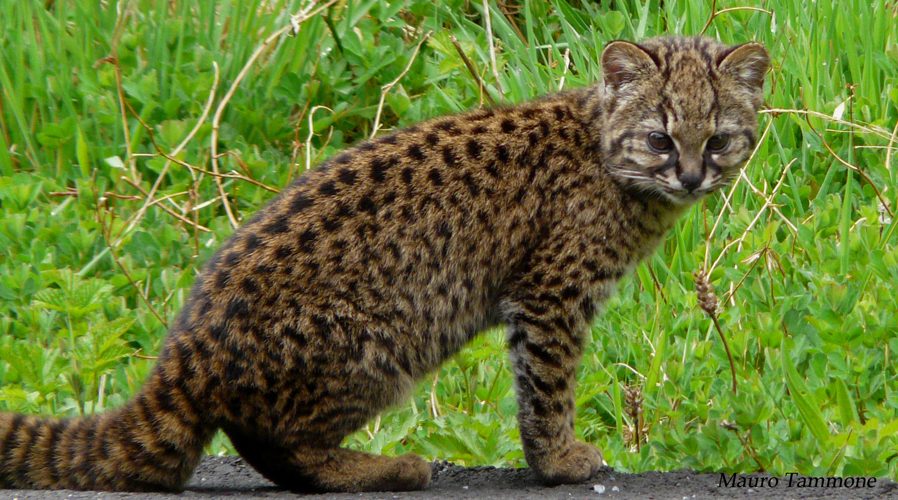
Wild image · Puyehue National Park · Chile
Meet the cat
Kodkod
Leopardus guigna
The smallest cat in the Americas, closely bound to the temperate forests of Chile and Argentina.
ConservationLeast ConcernLC
Relative sizeSmall
ActivityNocturnal
LineageOcelot
Weight1.5–3 kg
Body length37–56 cm
Tail length20–25 cm
The smallest cat in the Americas
A kodkod can live beside people—if the green pathways remain.
Also called the guiña, this tiny Chilean forest cat may weigh less than many domestic cats. Its coat is packed with small dark spots, its thick tail carries black rings, and in some southern landscapes an all-black coat is remarkably common.
Kodkods hunt mostly on the ground but climb readily, using trees to escape danger and dense vegetation to rest. What looks like one continuous species on a map is now understood as six geographic groups with different genetics, population sizes, and risks.
Habitat and range
Forest does not have to be endless—but it does have to connect.
Kodkods live in central and southern Chile and a narrow strip of southwestern Argentina. Native temperate rainforest, Patagonian forest, Mediterranean woodland, bamboo-rich understory, and thick matorral provide their core habitat.
They also enter secondary forest, plantations, and agricultural mosaics. The crucial detail is cover: in fragmented country they follow hedgerows, streamside vegetation, and forest corridors, while avoiding broad grazed pasture with little vegetation. Even gaps of roughly 100 meters can become meaningful barriers.
How it belongs
Built for this particular world.
Small enough for dense cover
A climber with ground-game
Two coats, many local stories
The conservation reality
A new global category does not erase local danger.
The current global assessment classifies the kodkod as Least Concern, but the trend is uncertain and several geographic groups remain very small. Northern, central, and Argentine groups face especially high near-term risk.
- Native-forest loss and fragmentation
- Removal of understory and movement corridors
- Road mortality
- Retaliatory killing around poultry
- Free-ranging dogs and disease
- Fire and climate-driven habitat change
What effective work looks like
Reconnect the forest at the scale of a very small cat.
Kodkod conservation can work inside lived-in landscapes when native vegetation, safe crossings, and practical coexistence are designed together.
Protect native forest structure
Retaining understory, bamboo, mature forest patches, and streamside vegetation preserves both shelter and hunting habitat.
Build short connections that matter
Hedgerows, vegetated corridors, plantation management, and road crossings can reconnect fragments a cat may otherwise avoid.
Make coexistence local and practical
Secure poultry housing, dog management, community monitoring, and rapid response reduce conflict without asking families to absorb the cost.
From hope to participation
Sometimes conservation is the distance between two patches of cover.
Zoo-EV will connect the kodkod’s story to landscape-scale research and community coexistence. Participation helps make the invisible routes between forest fragments visible—and worth protecting.
Participate in the missionScientific sources, review, and image provenance
Scientific review: August 23, 2026. This account will continue to change when stronger evidence or updated specialist assessments become available.
- IUCN SSC Cat Specialist Group · Kodkod
- CatSG species assessment · Kodkod
- Image: Mauro Tammone · wild · Puyehue National Park · Chile · CC BY 3.0