
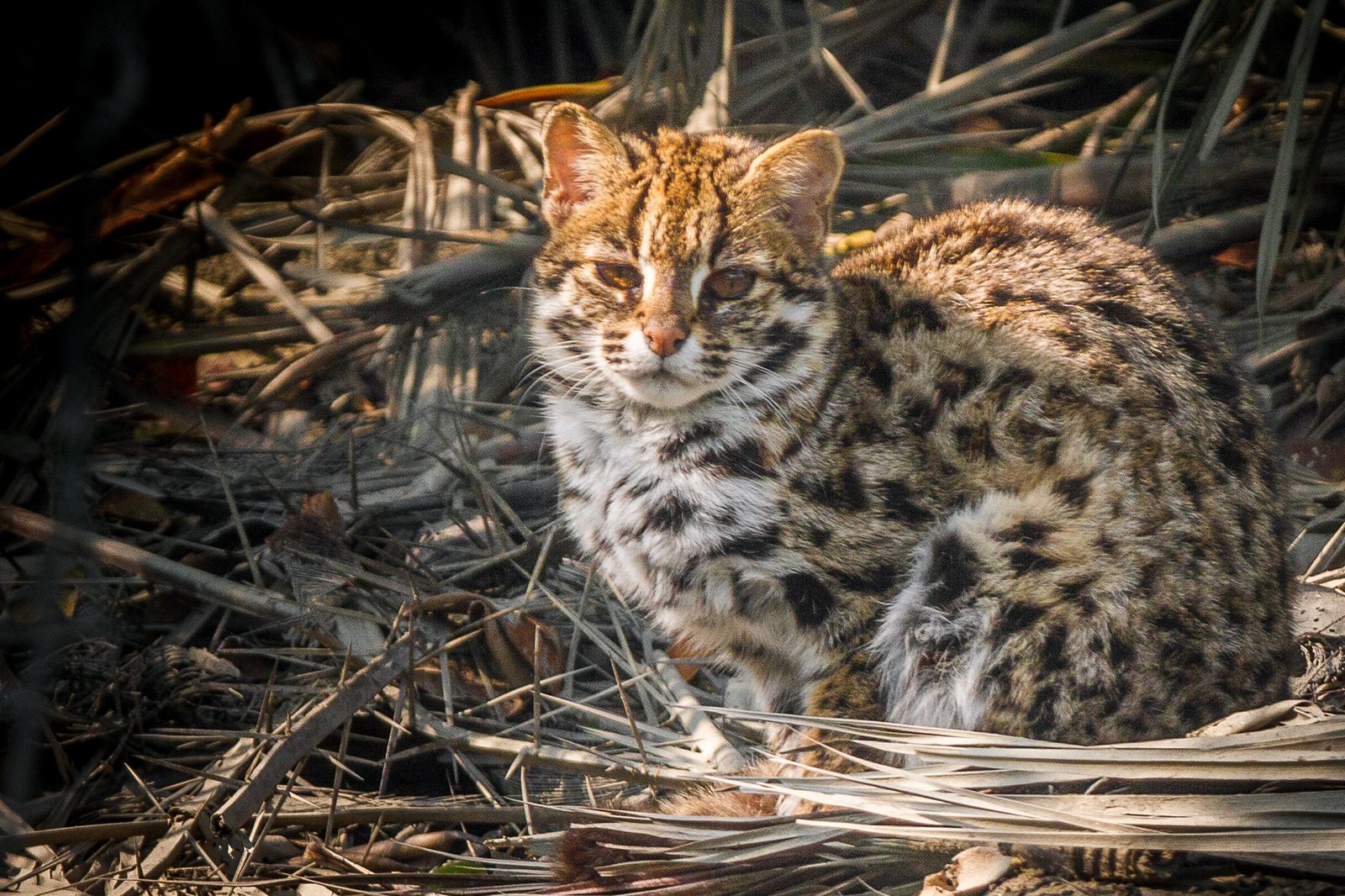
Wild image · Sundarban Tiger Reserve · West Bengal, India
Meet the cat
Mainland leopard cat
Prionailurus bengalensis
A widespread Asian small cat able to use natural forest and some human-modified landscapes.
ConservationLeast ConcernLC
Relative sizeSmall
ActivityNocturnal
LineageLeopard cat
Weight1.6–8 kg
Body length45–65 cm
Tail length20–30 cm
The little leopard across a continent
One small cat changes its coat from tropical forest to snowy oak woodland.
The mainland leopard cat is long-legged, slender, and marked with spots that vary dramatically across Asia. Tropical cats tend to be smaller and warm ochre; northern cats can be larger, greyer, and wrapped in thicker fur.
Its adaptability is real. Leopard cats climb, swim, hunt rodents and other small prey, and use everything from rainforest and mountain forest to logged woodland and some plantations. But the species’ broad range contains isolated island cats, regional declines, and places where survival outside protected habitat remains low.
Habitat and range
From mangrove country to forests above 4,500 meters.
Mainland leopard cats range from Pakistan and the Himalayan foothills through China, Korea, the Russian Far East, and mainland Southeast Asia, with populations on Taiwan and small Japanese islands. Records extend from sea level to at least 4,579 meters in China.
They use tropical, temperate, and coniferous forests, shrub, successional grassland, riparian habitat, agricultural wetlands, and plantations. Forest fragments and water-edge vegetation often remain important for resting, breeding, and moving even where the cats hunt in altered land.
How it belongs
Built for this particular world.
A coat tuned by latitude
A hunter above and beside water
Rodents create opportunity
The conservation reality
Widespread is an average—and the average can hide islands in trouble.
The species is globally classified as Least Concern and considered stable overall, yet population knowledge is uneven. The Iriomote and Tsushima island populations are small, genetically limited, and exposed to intense local pressures.
- Hunting, snaring, and illegal trade
- Retaliatory killing around poultry
- Road mortality
- Forest loss and fragmentation
- Free-ranging dogs and disease
- Isolation and low genetic diversity on islands
What effective work looks like
Treat a continental species as many local conservation realities.
The right response in a mainland forest is not automatically the right response on a small island. Monitoring and action must match the population, habitat, and dominant source of mortality.
Close regional knowledge gaps
Comparable camera-trap, genetic, and mortality studies can reveal where apparent tolerance is masking a decline.
Keep refuge beside altered land
Protecting forest fragments, river corridors, breeding cover, and safe movement routes makes working landscapes genuinely usable.
Target the immediate cause of loss
Snare removal, trade enforcement, poultry protection, road mitigation, and dog management should respond to evidence from each population.
From hope to participation
The split between mainland and Sunda cats is only the beginning of the story.
Zoo-EV will keep the mainland leopard cat distinct from its island relative while showing the variation within this enormous range. Participation supports the regional evidence that a single global label cannot provide.
Participate in the missionScientific sources, review, and image provenance
Scientific review: August 23, 2026. This account will continue to change when stronger evidence or updated specialist assessments become available.
- IUCN SSC Cat Specialist Group · Mainland leopard cat
- CatSG species assessment · Mainland leopard cat
- 2017 revised taxonomy of Felidae
- Image: Soumyajit Nandy · wild · Sundarban Tiger Reserve · West Bengal, India · CC BY-SA 4.0