
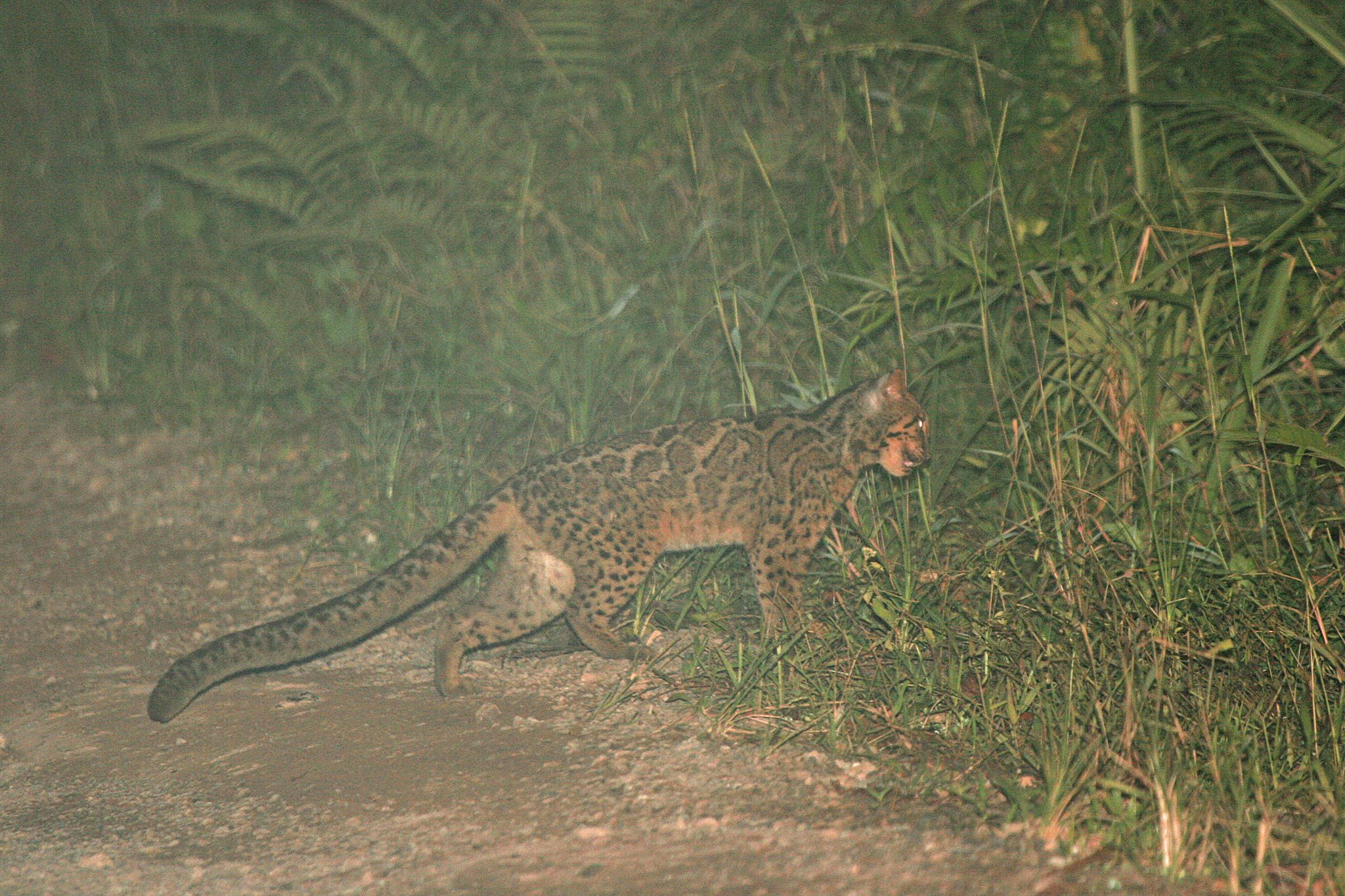
Wild image · Sabah · Malaysia
Meet the cat
Marbled cat
Pardofelis marmorata
A long-tailed Asian forest cat whose movement and markings echo the clouded leopards.
ConservationNear ThreatenedNT
Relative sizeSmall
ActivityNocturnal
LineageBay cat
Weight2–5 kg
Body length45–62 cm
Tail length36–55 cm
A clouded-leopard look in a house-cat body
The resemblance fooled us. The family tree told a different story.
Large marbled blotches, short legs, broad paws, and a tail nearly as long as the body once made this cat seem like a miniature relative of the clouded leopards. Genetics instead placed it beside the Asian golden cat and Bornean bay cat.
That enormous tail works like a counterbalance in the canopy. Marbled cats can climb down a trunk headfirst, and one watched in Borneo rested 25 meters above the ground before moving through the branches and descending face-first to escape a spotlight.
Habitat and range
A wide map held together by tree cover.
Marbled cats occur from the eastern Himalayas through mainland Southeast Asia to Peninsular Malaysia, Sumatra, and Borneo. They are strongly associated with moist evergreen, mixed deciduous-evergreen, montane, and peat-swamp forests.
Records also come from logged forest, agroforestry, plantations, and tiny remnants among coffee farms—but canopy cover remains the common thread. A record in altered habitat does not prove a population can persist there for generations.
How it belongs
Built for this particular world.
A tail built like a balancing pole
Headfirst is a real direction
Clouds without the clouded-leopard ancestry
The conservation reality
The forest is disappearing faster than this cat is being understood.
The marbled cat is Near Threatened, but its population trend and much of its ecology remain poorly known. Across a broad range it is often detected less frequently than larger and better-known forest cats.
- Deforestation and forest conversion
- Logging and lost canopy continuity
- Oil-palm, rubber, coffee, and other plantations
- Indiscriminate snaring
- Hunting for meat, fur, bones, and traditional use
- Fragmentation around roads and settlements
What effective work looks like
Keep the canopy connected—and find out what happens below it.
Conservation needs intact forest, but it also needs better evidence about when logged forest, agroforestry, and small remnants support resident cats rather than occasional visitors.
Survey across the full forest gradient
Camera traps on the ground and targeted canopy observation can compare primary, logged, restored, and agricultural forest mosaics.
Protect connected tree cover
Forest corridors and reduced fragmentation preserve movement routes across both branches and the landscape beneath them.
Remove indiscriminate snares
Patrols, community partnerships, and alternatives to wire snaring protect marbled cats along with many other forest species.
From hope to participation
A spectacular climber should not remain a footnote in forest conservation.
Zoo-EV will connect the marbled cat’s visual appeal to the less visible work of canopy protection, snare removal, and long-term field research across Southeast Asia.
Participate in the missionScientific sources, review, and image provenance
Scientific review: August 23, 2026. This account will continue to change when stronger evidence or updated specialist assessments become available.
- IUCN SSC Cat Specialist Group · Marbled cat
- 2017 revised taxonomy of Felidae
- Image: James Eaton · wild · Sabah · Malaysia · CC0 1.0