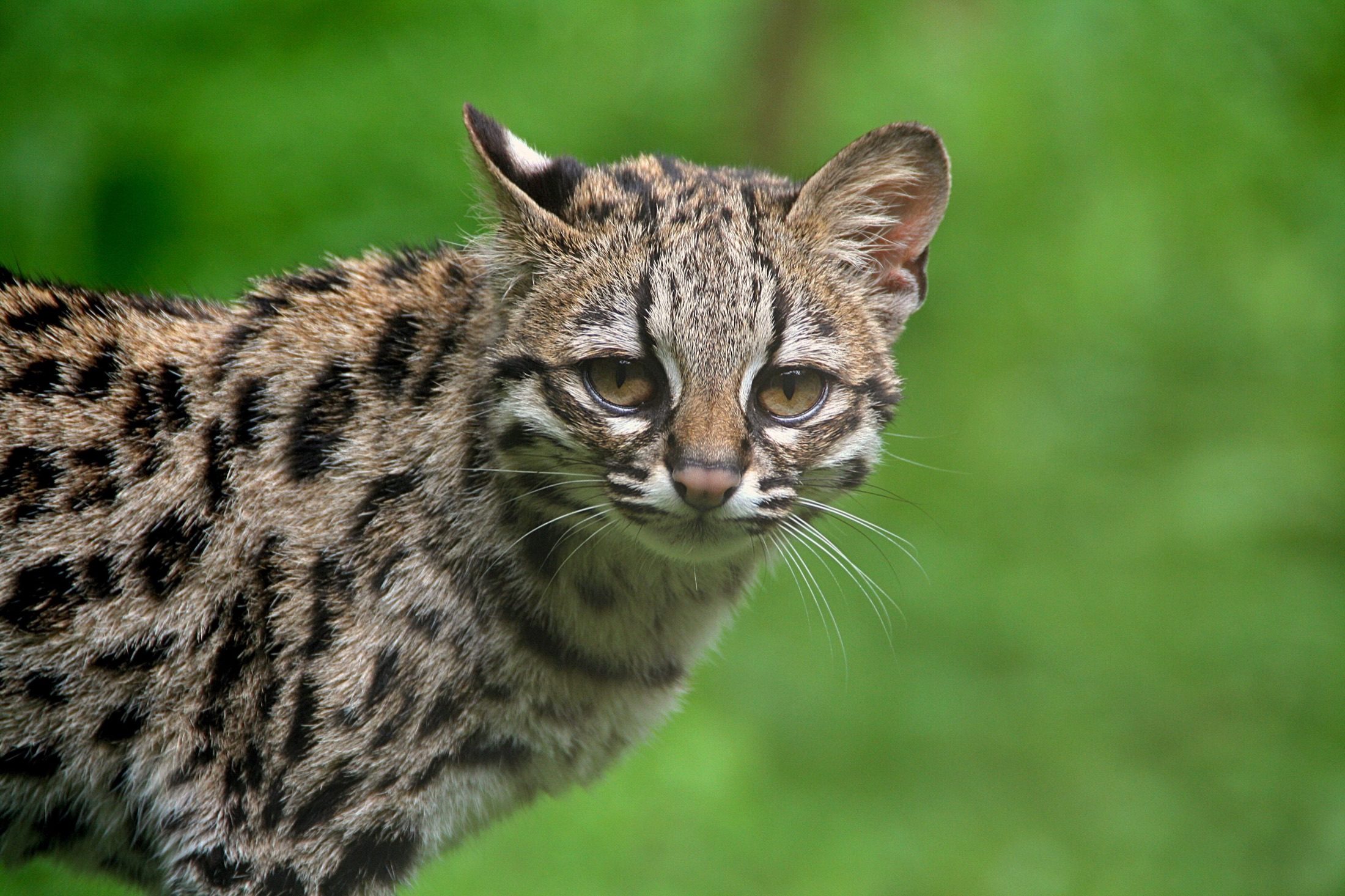
Captive image · Parc des Félins · France
Meet the cat
Margay
Leopardus wiedii
Flexible ankles help this canopy specialist descend trees headfirst.
ConservationNear ThreatenedNT
Relative sizeSmall
ActivityNocturnal
LineageOcelot
Weight2.3–4.9 kg
Body length46–69 cm
Tail length23–52 cm
The cat whose ankles turn the other way
A margay can descend a tree headfirst—and hang by one hind foot.
Large paws, a tail that can reach 70 percent of its body length, and hind feet capable of rotating around 180 degrees give the margay extraordinary control in trees. It can grip with all four feet, reverse down a trunk, and suspend itself while reaching for the next hold.
The surprise is that ‘tree cat’ is only part of the story. Margays rest in trees and possess exceptional climbing skills, yet available evidence suggests much of their traveling and hunting happens on the ground. One wild margay was even observed imitating the call of a pied tamarin while attempting to draw the monkeys closer.
Habitat and range
Where the canopy breaks apart, the margay’s world breaks with it.
Margays range from Mexico through Central and South America to Uruguay and northern Argentina. They are strongly associated with tropical and subtropical forest, including evergreen, seasonal, montane cloud, floodplain, and gallery forests.
They sometimes use disturbed forest, old plantations, and agriculture-forest mosaics when enough tree cover remains. That condition matters: sightings at a plantation edge do not mean the open landscape can replace connected forest.
How it belongs
Built for this particular world.
Ankles built to reverse
A tail made for balance
Eyes for a nocturnal forest
The conservation reality
Exceptional climbing cannot bridge a landscape without trees.
The margay is classified as Near Threatened and is generally uncommon or rare. Forest loss is compounded by low reproductive output, road mortality, illegal trade, and competition or killing by larger ocelots.
- Deforestation and forest fragmentation
- Conversion to pasture and plantations
- Road mortality
- Illegal pet and skin trade
- Retaliatory killing around poultry
- Low reproductive rate and disease outbreaks
What effective work looks like
Keep forests connected from the ground into the canopy.
Margay conservation depends on more than isolated reserves. Forest structure, movement routes, and safer edges determine whether small populations remain connected.
Protect continuous tree cover
Native forest, gallery corridors, and structurally complex regrowth give margays places to rest, hunt, and move.
Study life beyond the climbing myth
Telemetry, camera traps, and demographic research can show how margays divide their time between canopy and ground.
Reduce mortality around fragments
Road planning, poultry protection, trade enforcement, and community response can make forest edges less dangerous.
From hope to participation
Wonder begins in the ankles. Conservation begins with the whole forest.
Zoo-EV will use the margay’s unforgettable movement to open a larger story about connected canopies, viable populations, and the overlooked costs of fragmentation.
Participate in the missionScientific sources, review, and image provenance
Scientific review: August 23, 2026. This account will continue to change when stronger evidence or updated specialist assessments become available.
- IUCN SSC Cat Specialist Group · Margay
- CatSG species account · Margay
- Image: Clément Bardot · captive · Parc des Félins · France · CC BY-SA 3.0