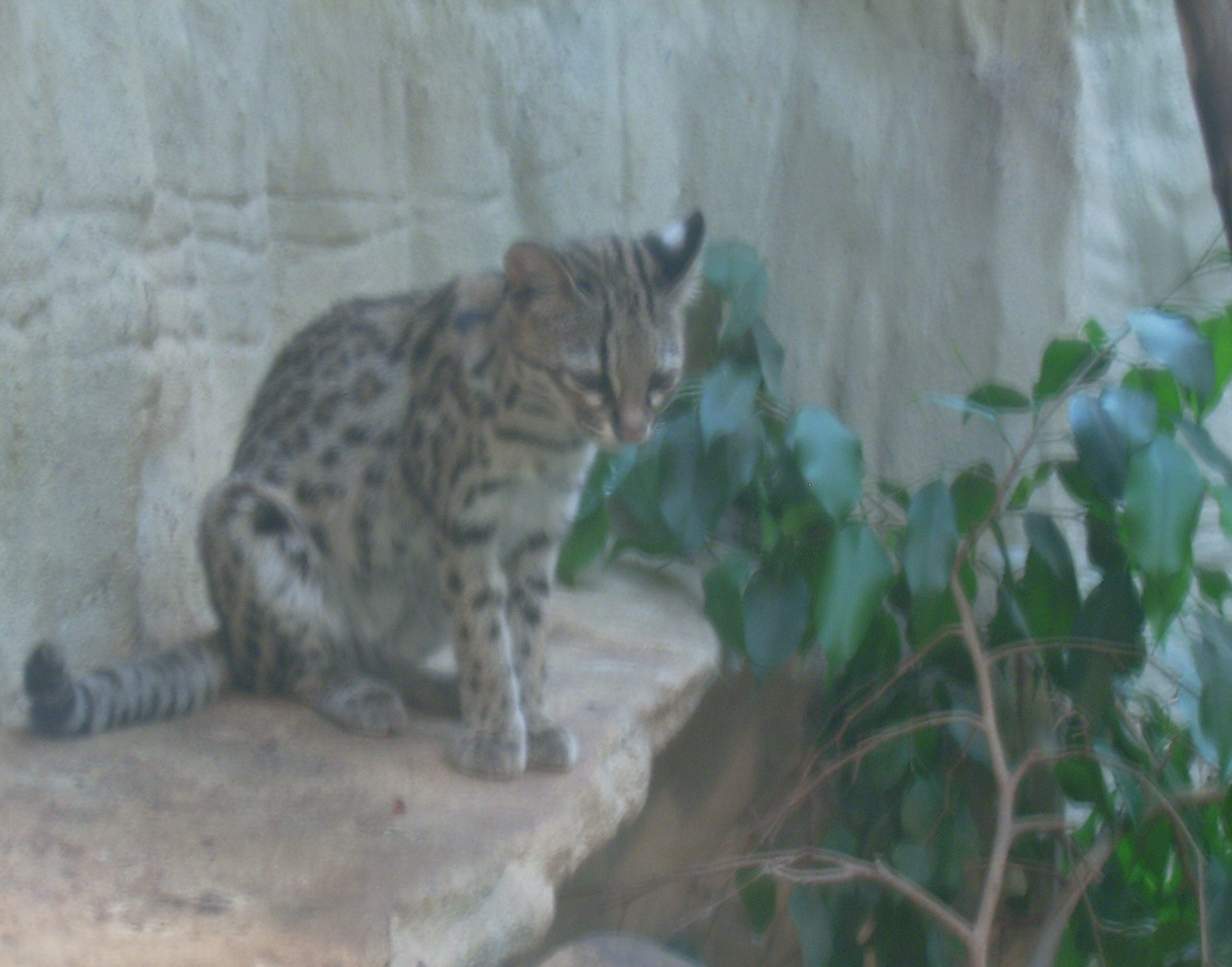
Captive image · Prague Zoo · Czech Republic
Meet the cat
Northern tiger cat
Leopardus tigrinus
A tiny spotted cat of fragmented forests and savannas across the Guiana Shield and northeastern Brazil.
ConservationVulnerableVU
Relative sizeSmall
ActivityNocturnal
LineageOcelot
Weight1.8–3.5 kg
Body length38–59 cm
Tail length20–42 cm
A tiny cat inside a changing family tree
The spots look simple. The species story is anything but.
Northern tiger cats are slender, lightly built, and often smaller than a domestic cat. Their warm yellow-to-grey coats carry many small rosettes and solid spots, while some individuals are completely black.
For years, similar-looking tiger cats across Central and South America were grouped and divided in different ways. A 2024 integrative study supports recognizing the clouded tiger cat separately. Zoo-EV therefore uses northern tiger cat for the Guiana Shield and central to northeastern Brazil while clearly labeling that specialist adoption and range boundaries are still being reviewed.
Habitat and range
The strongest populations may live beyond the usual protected map.
Under Zoo-EV’s working treatment, northern tiger cats occupy savannas, shrublands, dry forest, and forest mosaics across the Guiana Shield and central to northeastern Brazil, including Cerrado and Caatinga landscapes.
They climb extremely well but hunt much of their small prey on the ground. Densities can be surprisingly low, especially where ocelots are common. That ecological pressure may push important populations into areas outside conventional reserves—exactly where habitat conversion is often fastest.
How it belongs
Built for this particular world.
A house-cat scale predator
Climbing skill, terrestrial hunt
Rosettes that hide complexity
The conservation reality
Rarity, fragmentation, and taxonomic uncertainty stack together.
The northern tiger cat is classified as Vulnerable under the current assessment. Low densities, shrinking natural cover, and unresolved population boundaries make it difficult to know exactly where conservation effort will have the greatest effect.
- Cerrado and Caatinga habitat conversion
- Fragmented populations outside protected areas
- Road mortality
- Retaliatory killing and local trade
- Free-ranging dogs and disease
- Large ecological and taxonomic knowledge gaps
What effective work looks like
Protect the cat while the scientific map is still being redrawn.
Taxonomic review cannot become a reason to wait. Conservation can preserve populations and the connections between them while research clarifies which names those populations carry.
Resolve identity with range-wide evidence
Genetics, morphology, museum records, and camera surveys can test species boundaries without borrowing assumptions from look-alike cats.
Work outside protected areas
Native vegetation on farms, private reserves, and working landscapes may hold populations poorly represented inside major parks.
Reduce direct and indirect mortality
Road mitigation, poultry protection, dog management, and trade enforcement address threats that taxonomy will not solve.
From hope to participation
Changing names should sharpen attention—not lose it.
Zoo-EV will keep this page visibly dated and connect the 41st-entry story to conservation on the ground. Participation means supporting the research and habitat protection that remain valuable under any final classification.
Participate in the missionScientific sources, review, and image provenance
Scientific review: August 23, 2026. This account will continue to change when stronger evidence or updated specialist assessments become available.
- IUCN SSC Cat Specialist Group · Northern tiger cat
- 2024 integrative study · Clouded tiger cat
- 2017 revised taxonomy of Felidae
- Image: Altaipanther · captive · Prague Zoo · Czech Republic · Public domain