
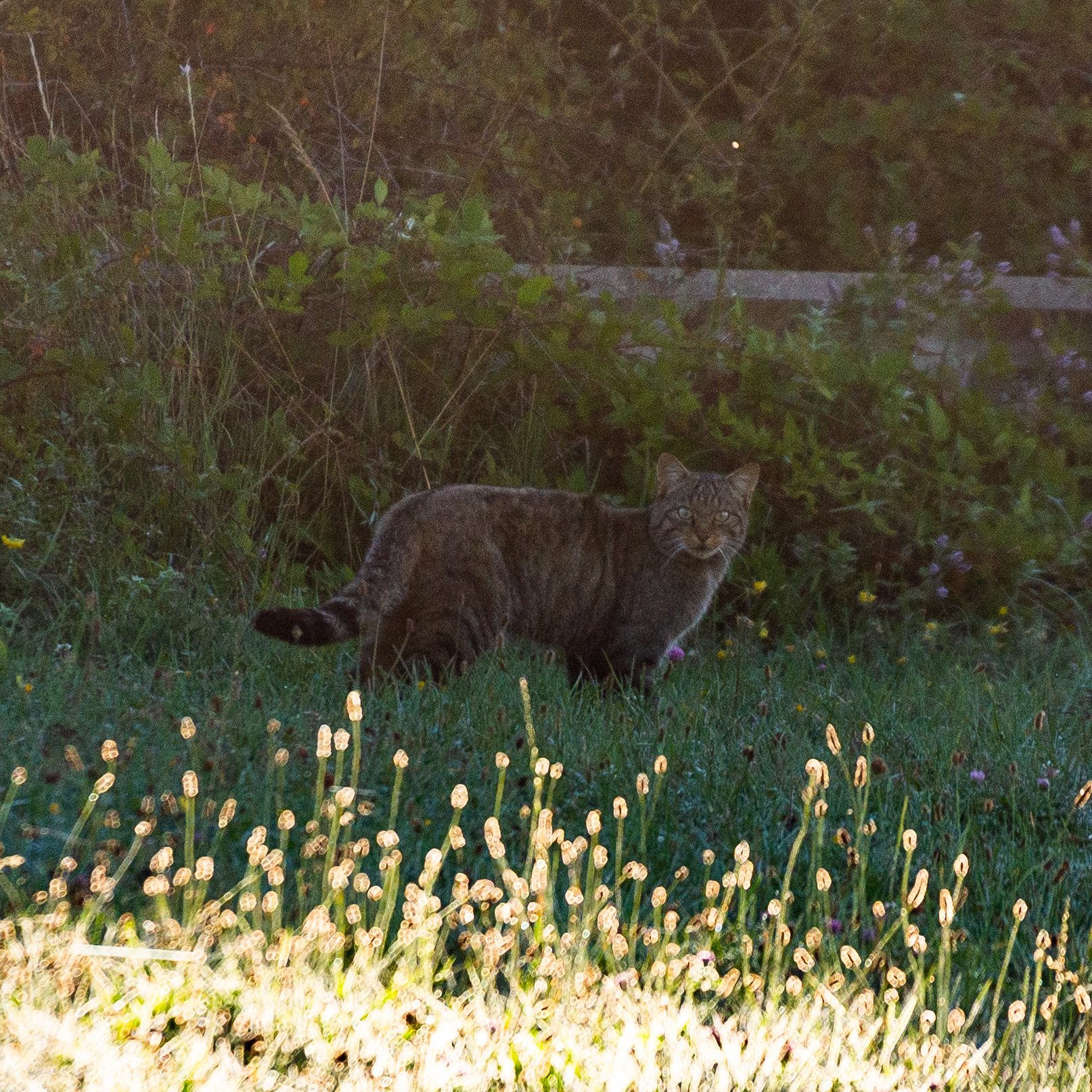
Wild image · Palencia · Spain
Meet the cat
European wildcat
Felis silvestris
A thick-tailed forest cat whose future is complicated by habitat fragmentation and hybridization.
ConservationLeast ConcernLC
Relative sizeSmall
ActivityNocturnal
LineageDomestic cat
Weight3–8 kg
Body length45–80 cm
Tail lengthAbout 30 cm
The forest cat beside us
Familiar at first glance, unmistakably wild in its own history.
A European wildcat can resemble a large tabby, but the broad head, thick grey-brown coat, strong dorsal stripe, and blunt, bushy, black-ringed tail belong to a distinct forest lineage. The domestic cat descends from the Afro-Asiatic wildcat—not from this species.
European wildcats survived centuries of persecution and habitat loss in scattered strongholds. Some populations are now expanding back into former range, creating a conservation story with both genuine hope and difficult questions about connectivity and hybridisation.
Habitat and range
Forest structure matters more than a simple forest label.
European wildcats are most closely associated with broad-leaved and mixed forests rich in cover, resting sites, and edges. They also use Mediterranean scrub, riparian woodland, steppe, wetland margins, and agricultural mosaics where substantial forest remains nearby.
Males may travel widely into open ground to hunt, while females appear more dependent on shelter for raising young. Corridors between forest blocks can determine whether recovering populations reconnect or remain isolated.
How it belongs
Built for this particular world.
A winter coat with volume
A tail that tells the story
A ground hunter using forest cover
The conservation reality
Least Concern globally does not describe every population.
The European wildcat is globally classified as Least Concern, but national conditions range from expansion to severe fragmentation and near disappearance. A broad status can conceal urgent local realities.
- Hybridisation with domestic cats
- Disease and competition from free-ranging cats
- Road mortality
- Habitat fragmentation and lost connectivity
- Rodenticides and incidental killing
- Illegal persecution in parts of the range
What effective work looks like
Recovery depends on connected forests and clear genetic evidence.
The species has recolonized parts of Europe under stronger protection. The next challenge is to connect populations while managing contact with domestic and feral cats.
Identify wildcats consistently
Shared genetic and morphological standards help conservationists distinguish wildcats, domestic cats, and hybrids.
Reconnect forest populations
Corridors, road crossings, and structurally rich habitat allow movement without forcing cats through high-risk landscapes.
Reduce domestic-cat impacts
Vaccination, sterilisation, responsible ownership, and targeted management address disease and hybridisation near wildcat habitat.
From hope to participation
This is a recovery story still being written.
Zoo-EV will highlight projects that pair forest connectivity with careful genetic monitoring. Participation can include responsible pet care and support for local habitat networks—small actions connected to a continent-scale return.
Participate in the missionScientific sources, review, and image provenance
Scientific review: August 22, 2026. This account will continue to change when stronger evidence or updated specialist assessments become available.
- IUCN SSC Cat Specialist Group · European wildcat
- European Wilderness Society · European wildcat
- Image: euqirneto · wild · Palencia · Spain · CC BY 4.0