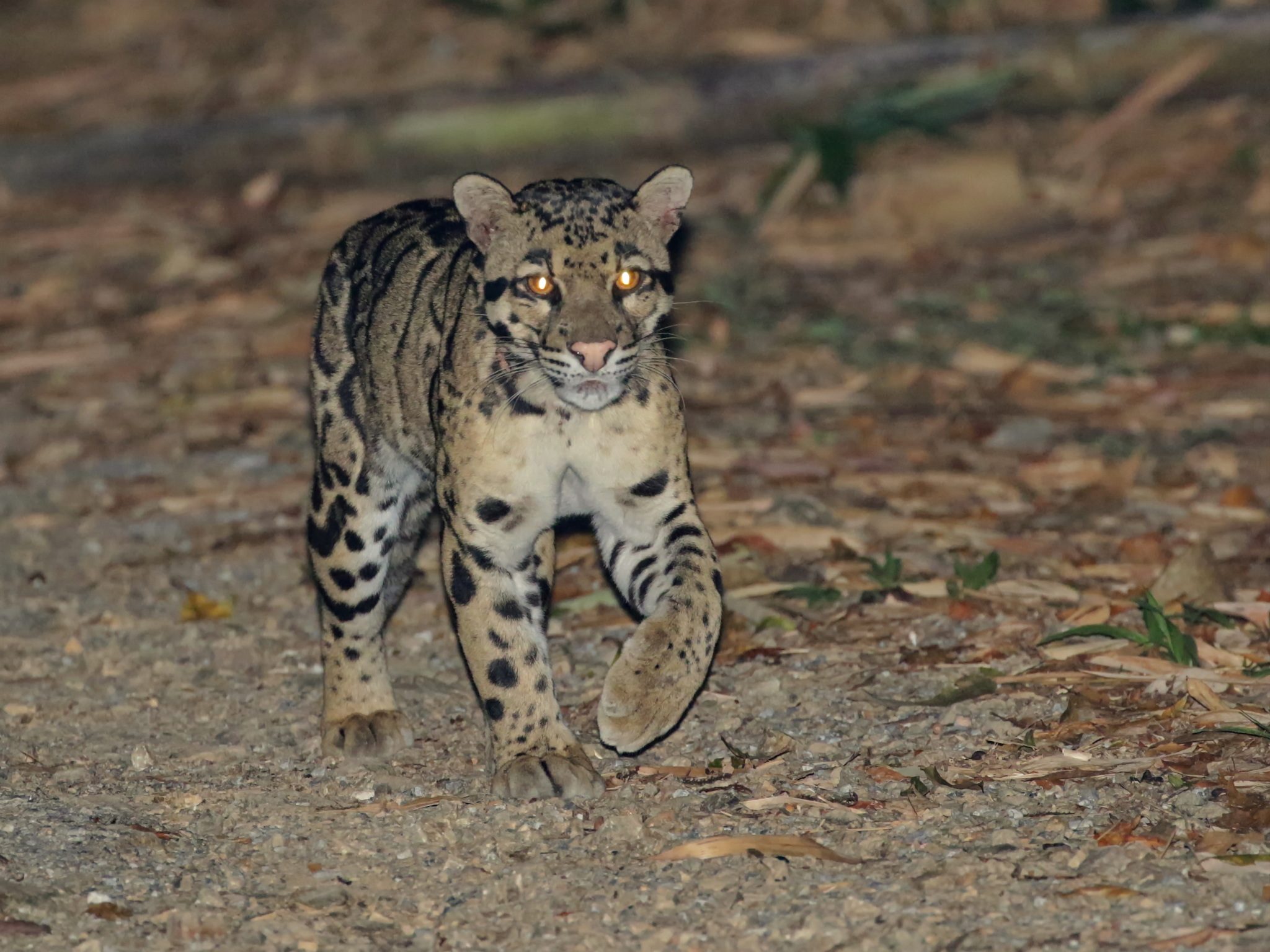
Wild image · Phetchaburi · Thailand
Meet the cat
Clouded leopard
Neofelis nebulosa
A powerful climber of mainland Asian forests, patterned with large cloud-like markings.
ConservationVulnerableVU
Relative sizeMedium
ActivityNocturnal
LineagePanthera
Weight16–23 kg
Body length69–108 cm
Tail length61–91 cm
A cat between familiar categories
It purrs like a small cat, moves like an acrobat, and carries canines built on a giant scale.
The mainland clouded leopard belongs to the big-cat branch, but it cannot roar. Its posture, feeding, and grooming resemble larger cats while its voice retains a purr. Even the usual labels begin to wobble around it.
Its anatomy is less ambiguous. Broad paws, short powerful legs, flexible ankles, longer hind limbs, and a tail nearly equal to the body turn a vertical forest into usable space. It can descend a trunk headfirst and hang from a branch by its hind feet.
Habitat and range
Dense forest is home; open ground is the crossing between rooms.
The species ranges from the Himalayan foothills through northeastern India, southern China, Indochina, and Peninsular Malaysia. Primary tropical evergreen forest is its strongest association, but records also come from secondary and logged forest, conifer forest, scrub, and some dry woodland.
It can use altered forest, yet consistently favors cover over open country. Across much of the range, roads, farms, dams, and plantations divide remaining habitat into smaller blocks even where a national map still appears green.
How it belongs
Built for this particular world.
A branch becomes a pathway
The living sabertooth comparison
Clouds that break the outline
The conservation reality
One of Asia’s most remarkable cats remains one of its least studied.
The mainland clouded leopard is Vulnerable. A plausible estimate places the mature population around 3,700–5,580, but uncertainty is wide and severe declines or possible local disappearance have occurred in parts of China and Indochina.
- Forest loss and fragmentation
- Roads, hydropower, and other infrastructure
- Snares and indiscriminate hunting
- Trade in skins, bones, meat, and live animals
- Declining prey
- Small isolated populations
- Limited ecological and population data
What effective work looks like
Protect a three-dimensional forest across a two-dimensional map.
Secure canopy matters, but so do the ground routes clouded leopards use between trees. Conservation has to connect forest blocks and reduce hunting pressure across the whole landscape.
Defend connected strongholds
Protected forests and working landscapes linked across borders can retain enough cover for dispersal and breeding populations.
Make forests free of snares
Sustained patrols, snare removal, trade enforcement, and locally credible alternatives address one of Southeast Asia’s broadest wildlife threats.
Study the cat without guessing
Comparable camera-trap surveys, genetics, and movement research can identify strongholds, barriers, and trends while keeping uncertainty visible.
From hope to participation
The cat that hangs by its feet should not be left hanging in the data.
Zoo-EV will connect wonder about the clouded leopard’s anatomy to the less glamorous work of snare removal, corridor protection, and long-term field research. Participation turns fascination into a better-known, safer forest.
Participate in the missionScientific sources, review, and image provenance
Scientific review: August 23, 2026. This account will continue to change when stronger evidence or updated specialist assessments become available.
- IUCN SSC Cat Specialist Group · Mainland clouded leopard
- 2017 revised taxonomy of Felidae
- Image: Ian Dugdale · wild · Phetchaburi · Thailand · CC BY 4.0