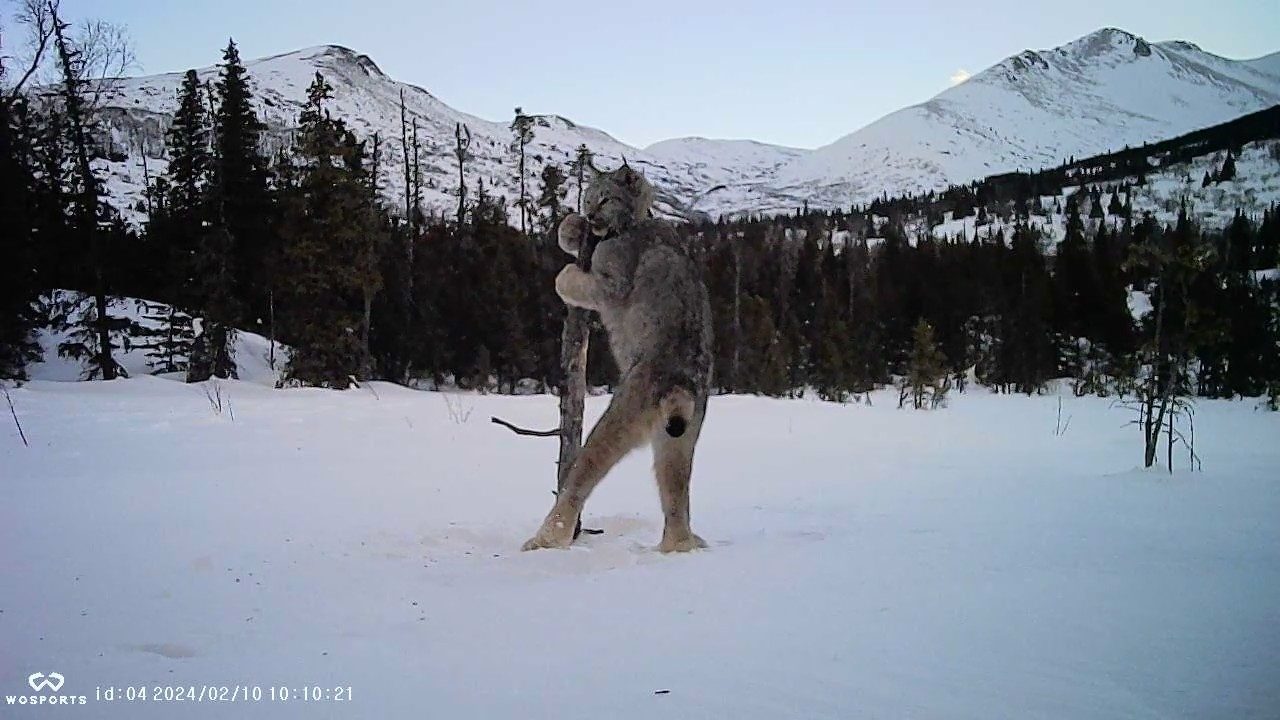
Wild image · Anchorage, Alaska · United States
Meet the cat
Canada lynx
Lynx canadensis
Huge, furred feet carry this northern specialist across deep snow in pursuit of snowshoe hares.
ConservationLeast ConcernLC
Relative sizeMedium
ActivityNocturnal
LineageLynx
Weight8–12 kg
Body length73–106 cm
Tail length10–15 cm
One cat follows one hare through a decade-long wave
When snowshoe hares rise and fall, Canada lynx rise and fall behind them.
No other cat is as tightly linked to a single prey species. Snowshoe hare numbers surge and crash in roughly eight-to-eleven-year cycles; Canada lynx numbers follow one or two years later. During a crash, litters shrink, survival falls, and hungry lynx may travel hundreds of kilometers.
Its body makes that pursuit possible. Huge spreading feet, densely furred between the pads, carry far less weight per step than a bobcat’s paws. Long hind legs keep the body moving through deep, loose snow where competing predators struggle.
Habitat and range
The right forest is not one age—it is a shifting mosaic.
Canada lynx occupy boreal and mixed boreal forest across Canada and Alaska, with smaller southern populations in the contiguous United States. Young, shrubby growth after fire or disturbance feeds snowshoe hares; older forest offers cover and fallen structures for dens.
That means conservation cannot freeze the forest in one condition. It must preserve large connected landscapes where patches change through time and where lynx can move north, uphill, or across borders when prey declines.
How it belongs
Built for this particular world.
Four living snowshoes
A body angled for depth
Reproduction reads the prey cycle
The conservation reality
Less snow changes who has the advantage.
The Canada lynx is globally Least Concern, but southern populations are fragmented and declining. Reduced snow cover, forest change, severe fires, and lost corridors narrow the conditions that favor a snow specialist.
- Declining snow depth and duration
- Forest loss and fragmentation
- Large, severe wildfires
- Incidental trapping
- Isolation of southern populations
- Competition as snow conditions change
What effective work looks like
Conserve movement as carefully as habitat.
A lynx tied to a cycling prey base cannot remain inside one small patch. Connected boreal forest and transboundary routes let animals respond to changing hare numbers, fire, and climate.
Protect boreal mosaics
Landscape planning should retain both hare-rich regrowth and mature denning cover across connected watersheds and mountain systems.
Keep north–south corridors open
Cross-border connections allow dispersal from secure northern populations into vulnerable southern range.
Match harvest to the cycle
Season closures, quotas, and trap modifications can reduce mortality during hare lows and prevent incidental capture.
From hope to participation
Follow the hare and an entire northern system comes into focus.
Zoo-EV will connect the lynx’s extraordinary snow adaptations to forest succession, climate, responsible trapping, and cross-border corridors. Participation means protecting the freedom to follow a moving world.
Participate in the missionScientific sources, review, and image provenance
Scientific review: August 23, 2026. This account will continue to change when stronger evidence or updated specialist assessments become available.
- IUCN SSC Cat Specialist Group · Canada lynx
- Cat Conservation Compendium · Canada lynx
- Image: Matt Muir · wild · Anchorage, Alaska · United States · CC BY 4.0