The cat hidden inside another species
A grainy camera-trap frame, millions of years of separation, and the evidence that taught science to see the Sunda clouded leopard.
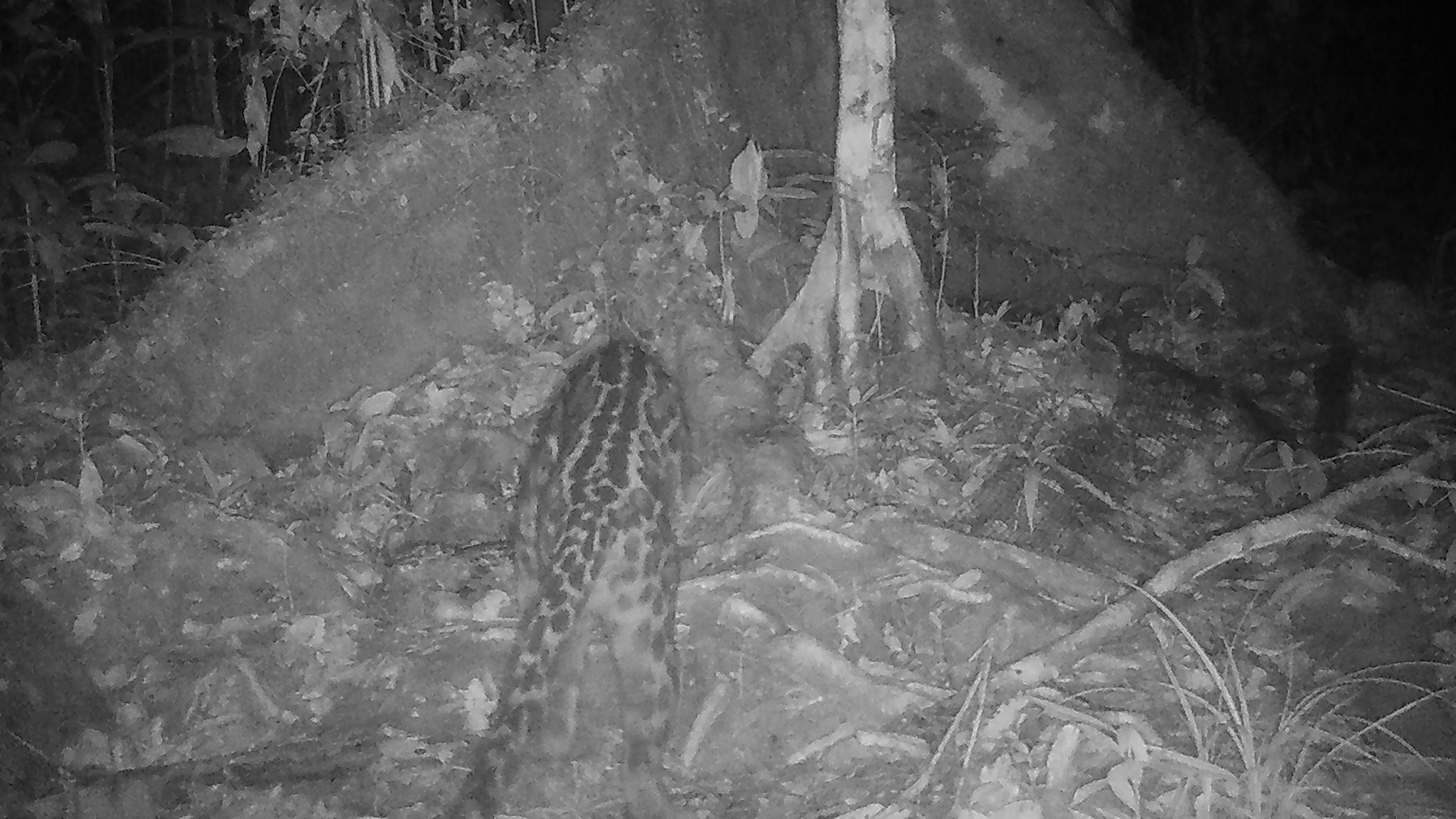
Wild image · Central Kalimantan, Indonesia · Justin Philbois
Published August 24, 2026
Nothing new stepped into the forest. The cat had been moving through Borneo and Sumatra all along—climbing, hunting, and passing unseen beneath the canopy.
What changed was the evidence. Researchers learned that the island clouded leopards were not simply a distant population of the mainland species. They carried a long, separate history of their own.
The split
Science did not add an animal. It gave an existing animal its own name.
For generations, clouded leopards from the Asian mainland, Borneo, and Sumatra were grouped as one species. Then multiple lines of evidence began to agree: mitochondrial DNA, chromosomes, skulls, teeth, and coat patterns all pointed toward deep separation.
The island lineage had developed independently for roughly 1.4 to 2.9 million years. In 2006 it was recognized as the Sunda clouded leopard, and later work distinguished Bornean and Sumatran subspecies within it.
Sometimes discovery is not finding a new animal. It is learning to see the animal that was already there.
The evidence
The photograph is imperfect. The encounter is not.
The infrared frame above has none of the polish of a wildlife portrait. That is precisely why it belongs here. Remote cameras allow a passing animal to record its own presence without a person standing nearby.
One photograph can confirm a species at a place. Repeated detections can begin to reveal activity, distribution, and survival. Genetics, measurements, and long-term field study then turn encounters into a larger scientific picture.
What recognition changes
A name makes an island story impossible to ignore.
The Sunda clouded leopard lives nowhere beyond Borneo and Sumatra. Some logged forest can support it, but conversion to oil palm generally cannot. Snares, illegal trade, prey loss, and the fragmentation of large forest blocks add direct pressure.
Recognizing the species clarifies the responsibility. Its future cannot be secured by assuming that clouded leopards are doing well somewhere else. The forests between the photographs have to remain connected here.
Continue the discovery
Meet the cats in this story.
Scientific sources and image provenance
Image: Wild image · Central Kalimantan, Indonesia. Justin Philbois. CC0 1.0.